Christmas Light Installation Cost by Home Size
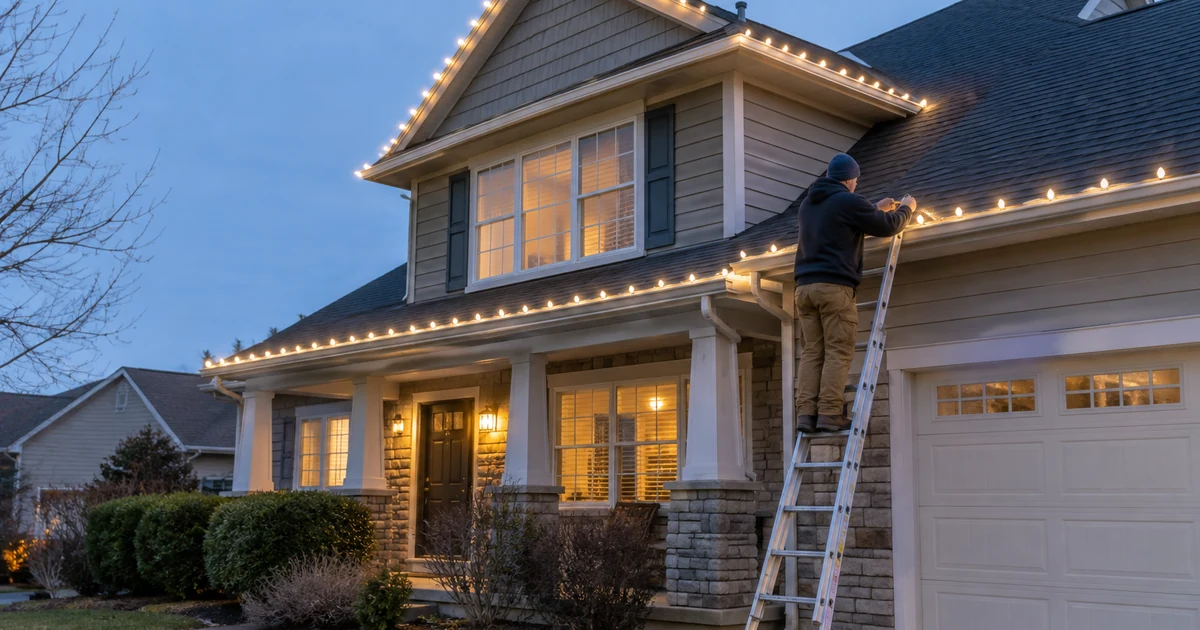
Most installers price holiday lighting by the linear foot of roofline, gutters and trim they cover, so the size and height of your house set the baseline. A small ranch with a simple roofline needs far less footage, ladder time and safety gear than a tall two-story with several peaks.
| Home type | Typical lit footage | Typical installed cost | Notes |
|---|---|---|---|
| Small one-story | 100–150 ft | $200–$450 | Roofline and front windows |
| Average two-story | 150–250 ft | $350–$800 | Most common residential quote |
| Large or three-story | 250–400 ft | $700–$1,500 | Taller ladders or lifts, more peaks |
| Estate or custom display | 400+ ft | $1,000–$2,500+ | Trees, landscape and yard displays |
National averages cluster around $420 to $450, and most homeowners pay roughly $220 to $690 for a professional install of roofline lights on a typical house. Full packages that add wrapped trees, shrubs, garland and pathway lighting commonly run $750 to $5,000.
Installers usually set a job minimum, often $150 to $300, so even a short run of lights on a small home rarely costs less than that. On the other end, steep roofs and three-story walls often carry a surcharge of about 20%.
Cost per linear foot
The per-foot rate is the easiest way to compare quotes. Here is how the most common pricing models break down:
| Pricing model | Cost per linear foot | What it covers |
|---|---|---|
| Labor only (you supply lights) | $1.50–$5 | Hanging, clips, testing |
| Installer-supplied lights (lease) | $2–$5 | Lights, clips, install, often takedown |
| New lights purchased plus install | $2.50–$7 | You keep the lights after the season |
| Steep or high roofs | $3.50–$6 | Extra safety equipment and time |
| Removal only | About $0.50–$0.65 | Takedown at end of season |
How to estimate your footage
You can get close to an installer’s number before anyone climbs a ladder. Measure the gutter line along the front of the house, then add the rake edges that run up each gable. Add the width of any front windows, porch railings or garage door you want outlined.
A typical single-story front with one gable often lands around 100 to 150 feet. A two-story front with two or three peaks commonly measures 150 to 250 feet. At $2 to $4.25 per foot, 150 feet works out to roughly $300 to $640, which is why most quotes for an average home sit near $450.
Cost Breakdown: Materials vs. Labor
Labor is the bigger share of a professional holiday lighting bill. The lights themselves are fairly cheap per foot, but the time spent on ladders, measuring runs, fitting clips and hiding cords is what you pay for.
- Installation labor: $1.50–$5 per linear foot, or about $60–$100 per hour when a handyman bills hourly
- Light strands: $0.50–$2 per linear foot; a 25-foot strand costs roughly $5–$39 for incandescent, $13–$60 for LED and $15–$70 for C9 bulbs
- Clips, extension cords and timers: timers run about $10–$50 each
- Takedown: $100–$400 per job, or around $0.50 per foot, when it isn’t bundled
- Minimum service fee: commonly $150–$300 per visit
Commercial-grade C7 and C9 LED strings, the large-bulb style most pros hang on rooflines, cost more than store-bought mini lights but hold up better on a roof and use far less power.
Light strand prices by type
If you buy your own lights or want to check an installer’s material line, these are typical retail prices per 25-foot strand:
| Light type | Price per 25-ft strand | Best use |
|---|---|---|
| Mini incandescent | $5–$39 | Shrubs, railings, indoor trees |
| Mini LED | $13–$60 | Shrubs, trees, windows |
| Dome / wide-angle LED | $6–$15 | Bright accent runs |
| C7 / C9 bulbs | $15–$70 | Rooflines and gutters |
| Smart / color-changing | $20–$200 | App-controlled displays |
What a professional quote should include
- A site visit or photo-based measurement with the total linear footage listed.
- Light type and color, and whether the lights are leased, sold to you, or yours.
- Clips, extension cords, timers and any outlet work needed to power the display.
- Service calls during the season if a strand or bulb fails.
- The takedown date and whether removal and storage are included.
- Proof of liability insurance.
Quotes that leave out takedown or service calls often look cheaper at first but end up close to, or above, an all-inclusive package.
Rental (lease) vs. buying your lights
Many companies offer a lease package: they supply commercial-grade lights, install them, take them down after the holidays and handle the lights between seasons. Rental packages generally cost $200 to $600 for a typical home, including install and takedown.
Buying the lights outright costs more the first year because you pay for the strands plus labor, about $2.50 to $7 per foot all in. In later years you pay labor only, which can make ownership cheaper if you keep the same design. The trade-off is that you must store, test and replace failed strands yourself, and some installers charge less or only warranty their work when they supply the lights.
Ask each company whether off-season storage is included. Some full-service providers keep leased lights labeled by house so the same layout goes back up next year; others hand everything back to you after takedown.
Other Factors That Affect the Price
Roof height and pitch
A single-story home with a low-slope roof can often be lit from a ladder. Second- and third-story eaves, steep pitches and dormers require roof harnesses, taller ladders or a lift. Expect roughly 20% more for difficult access.
Trees, shrubs and landscape lighting
Wrapping trees is priced by height. Small trees around 6 feet typically cost $75 to $200 to wrap, mid-size trees of 12 to 18 feet run $125 to $250, and large trees approaching 30 feet can cost $300 to $1,500 or more. Shrubs usually run $10 to $20 each.
Bulb style and color
Warm white C9 LEDs are the standard residential choice. Multicolor, color-changing and app-controlled smart strands cost more per foot, with smart lights ranging from about $20 to $200 per strand depending on features.
Power and outlets
Big displays can exceed what one exterior outlet supports. If you need a new GFCI outlet near the eaves or in the yard, plan on roughly $120 to $200 per outlet from an electrician. Our guide to electrician cost per hour explains how those calls are billed.
Timing in the season
Installers book up fast between early November and mid-December. Scheduling an install in October, or booking takedown at the same time, usually gets you a better slot and sometimes an early-booking discount.
Region
Labor rates differ a lot by metro area. In markets where holiday lighting is popular and crews are booked solid, per-foot pricing sits at the top of the national range.
Running costs after installation
The install is a one-time charge each season, but the display also shows up on your electric bill. A typical LED roofline display adds roughly $5 to $20 a month, while an incandescent display of similar size can add $30 to $75. Putting the lights on a timer, for example from dusk to 11 p.m., keeps that number down and means nobody has to remember to switch them off.
Repairs during the season
Wind, ice and squirrels can knock out a section mid-season. Many installers include service calls in the package. If yours doesn’t, bulb or strand replacement typically costs $20 to $50 per string, and electrical troubleshooting is billed at about $50 to $100 per hour.
Permanent lighting
Permanent track-mounted LED systems stay on the house year-round and switch between holiday and accent colors from an app. They average about $3,000 to $3,500 installed, so they make sense mainly if you would otherwise pay for a professional install every year.
Before you hire: get at least three written, itemized quotes from licensed and insured local pros. Prices for the same job often differ by 30% or more, and comparing line items is the fastest way to spot padding or missing work.
DIY vs. Hiring a Pro
Hanging lights yourself costs only the strands, clips and a timer, which can be under $100 for a modest roofline. The real cost is risk: ladder falls are a common source of holiday injuries, and working on a wet or icy roof is dangerous without fall protection.
A professional crew brings the ladders, harnesses and insurance, measures runs so cords stay hidden, and uses clips that won’t damage shingles or gutters. Many also return to fix a dead section during the season at no charge. For one-story homes with an easily reached gutter line, DIY is reasonable. For anything above the first floor, hiring an insured installer is the safer call.
If clogged gutters are holding debris, have them cleared before the lights go up so clips sit flat; see our guide to gutter cleaning cost. A general handyman can also hang simple lights at an hourly rate, covered in our handyman cost per hour guide.
How to Save Money on Christmas Light Installation
- Book early. Many companies offer lower rates or better scheduling for installs booked in September or October.
- Focus on the front. Lighting only the street-facing roofline and entry gives most of the visual impact at a fraction of the footage.
- Choose LED. LED strands typically add $5 to $20 a month to your electric bill, compared with $30 to $75 for incandescent.
- Compare lease and purchase over three years. If you’ll keep the same design, buying lights and paying labor only in later years can cost less.
- Bundle takedown and storage. Paying for install and removal together is usually cheaper than booking removal separately in January.
- Ask about multi-year contracts. Some installers discount returning customers who sign up for the next season.
- Get at least three quotes with footage, light type, takedown and storage spelled out.
If you have a crew on site for other exterior work in the fall, it’s also a good time to schedule a pressure washing of siding and walkways so the display shows against a clean house.
Frequently Asked Questions
How much does it cost to have Christmas lights put up?
Most homeowners pay $220 to $690 for professional installation, with national averages around $420 to $450. Large or three-story homes with trees and yard displays can reach $1,500 to $2,500 or more.
How much do installers charge per foot for Christmas lights?
Expect $2 to $5 per linear foot for typical installs. Labor-only jobs where you provide the lights can start near $1.50 per foot, while new lights plus install or steep roofs push rates to $5 to $7 per foot.
Does the price include taking the lights down?
Often, yes. Most rental (lease) packages include takedown, and many full-service companies bundle it. When it is billed separately, removal typically costs $100 to $400, or about $0.50 per foot.
Is it cheaper to rent or buy Christmas lights from an installer?
Renting is usually cheaper the first year, at roughly $200 to $600 for a typical home with install and takedown. Buying costs more upfront but you pay labor only in later years, so it can win if you keep the same design for several seasons.
When should I book Christmas light installation?
Book in September or October. Crews fill their calendars quickly in November, and early bookings sometimes get a discount.
Are permanent Christmas lights worth it?
Permanent LED track lighting averages about $3,000 to $3,500 installed. It can make sense if you’d otherwise pay $450 or more every year for professional installation and want lighting for other holidays too.
Should I tip Christmas light installers?
Tipping is optional. When homeowners do tip holiday light crews, 10% to 20% of the job price is a commonly cited range.