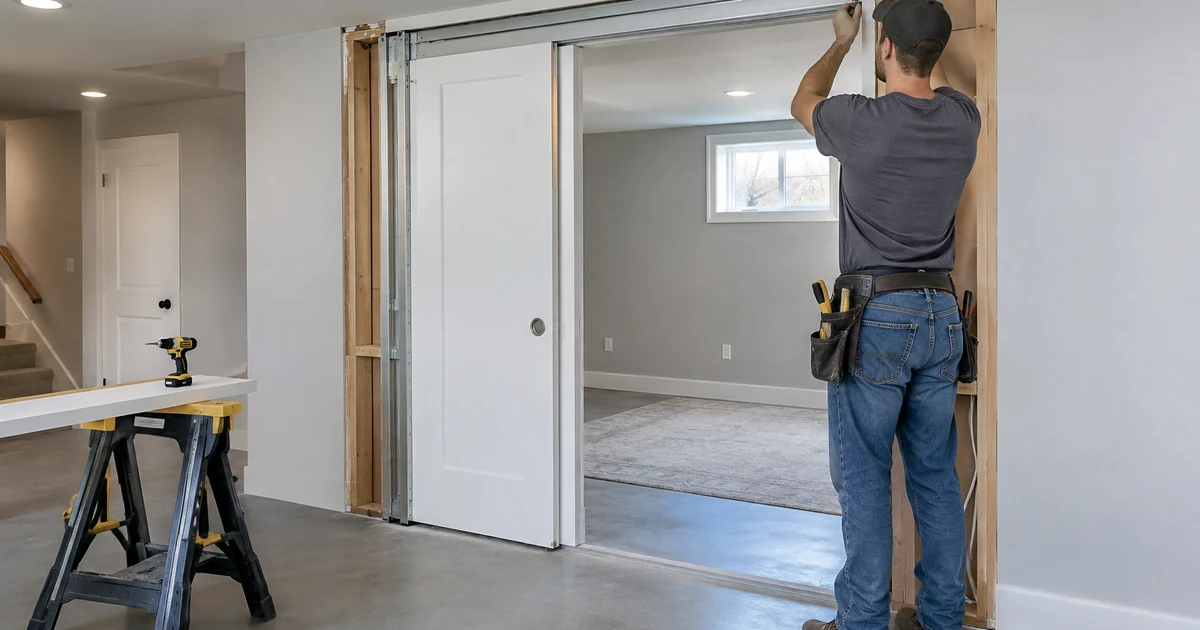
Pocket Door Installation Cost by Wall Type
The wall the door goes into matters more than the door itself. In new construction or an open remodel, the pocket frame drops in before drywall goes up, so labor is light. Retrofitting a pocket door into a finished wall means opening up the wall on both sides, moving whatever is inside it and rebuilding the surface afterward.
| Installation scenario | Typical installed cost | Labor | Time |
|---|---|---|---|
| New construction or open framing | $500–$2,000 | $100–$500 | A few hours |
| Existing non-load-bearing wall (retrofit) | $1,400–$3,000 | $1,000–$2,500 | 1–2 days |
| Existing load-bearing wall | $3,000–$6,000+ | Includes header, engineer and permit | Several days |
| Double pocket doors, existing wall | $1,700–$4,200 | About double a single door | 1–3 days |
National averages vary by source, from about $1,050 to $1,750, because they mix cheap new-construction jobs with retrofits. If you’re adding a pocket door to a finished wall in an existing home, which is the most common reason homeowners search for this cost, plan on about $2,000 for a single standard-width door in a non-load-bearing wall.
The retrofit premium comes from the wall itself. The installer has to remove drywall on at least one side, take out studs where the door will slide, frame a new header, install the pocket frame and track, then hang new drywall, tape, mud and paint. Our drywall repair cost guide shows what the patching and finishing part of that work typically costs on its own.
Cost by door width
Wider doors need a wider pocket, which means more wall to open and a longer header. The ranges below are for single doors installed.
| Door width | New construction | Existing wall |
|---|---|---|
| 32 inches | $450–$1,500 | $1,350–$2,500 |
| 34 inches | $500–$1,600 | $1,400–$2,800 |
| 36 inches | $550–$1,900 | $1,500–$2,950 |
| 46 inches | $600–$2,000 | $1,600–$3,100 |
| 48 inches | $700–$2,800 | $1,600–$3,800 |
| 60 inches | $800–$3,300 | $1,700–$4,300 |
A pocket door needs a stretch of clear wall roughly as wide as the door itself next to the opening, so the total rough opening is about twice the door width. A 36-inch door therefore takes up around six feet of wall, which must be free of switches, outlets, plumbing, ducts and heating units, or those have to be moved.
Pocket doors in new construction
When walls are still open, a pocket door costs only a little more than a standard prehung interior door. The framer leaves a wider rough opening with a header, the pocket frame kit is nailed in place, and the drywall crew hangs and finishes the wall as part of the larger job. That’s why installed prices in new construction can start around $500 for a hollow-core door. The main extra expense is a better frame kit: spending a bit more on a heavy-duty track and steel-reinforced split studs reduces the chance of costly repairs once the wall is closed.
Cost Breakdown: Materials vs. Labor
On a retrofit, labor and wall repair usually outweigh the cost of the door and hardware. In new construction, the door slab is often the largest line item.
- Pocket door frame kit (frame, track and rollers): about $130 or more for a standard heavy-duty aluminum-track kit; complete DIY kits run roughly $350–$600 depending on material
- Door slab: hollow-core panels are the cheapest; solid wood, glass and French-style doors cost several hundred dollars more
- Installation labor, new construction: $100–$500
- Installation labor, retrofit: about $1,000, up to $2,500 for complex jobs or load-bearing walls
- Demolition: about $2–$8 per square foot of wall, or $40–$80 per hour
- Old door removal and disposal: about $100, sometimes included in labor
- Painting the door: $75–$150, more if trim and wall need repainting
Cost by door material
| Door material | Installed, new construction | Added for an existing wall |
|---|---|---|
| Hollow core | $500–$800 | $900–$1,500 |
| Fiberglass | $600–$1,000 | $900–$1,800 |
| Solid wood | $600–$2,200 | $900–$1,800 |
| Glass | $550–$2,200 | $900–$1,800 |
| Aluminum | $600–$2,200 | $900–$2,000 |
What a retrofit quote should include
A complete quote for adding a pocket door to an existing wall covers several trades. Compare bids against this list:
- Confirming whether the wall is load-bearing and what runs inside it.
- Protecting floors and removing trim, the old door and drywall across the pocket area.
- Removing studs and framing a new header sized for the full rough opening.
- Rerouting any wiring, plumbing or ducts by licensed trades.
- Installing the pocket frame, track, rollers and split jambs, then hanging and adjusting the door.
- Hanging, taping and finishing new drywall on both sides.
- Installing casing and hardware, painting, and hauling away debris.
Low bids often leave out drywall finishing, paint or utility work. Those gaps are where retrofit budgets grow.
Glass and heavy solid wood doors look great but need a heavy-duty track rated for their weight. Ask the installer to confirm the frame kit’s weight rating before you order a door.
Other Factors That Affect the Price
Load-bearing walls
This is the factor that can double the price. A pocket door removes studs across roughly twice the door’s width, so in a load-bearing wall the opening needs a properly sized header and support carried down to the foundation. That work should be designed by a structural engineer and done under a building permit. Wall work involving a structural engineer commonly runs $1,200 to $2,500 or more on top of the door, and engineered plans plus permits alone can cost several hundred dollars. Never let anyone cut studs out of a wall until you know whether it’s load-bearing.
Wiring, plumbing and ductwork in the wall
Any switch, outlet or cable inside the pocket area has to be rerouted, since the door will slide through that space. Electricians typically charge $50 to $130 per hour. Moving a plumbing line averages around $1,250, and rerouting an air duct can cost $450 to $2,200. A wall with a toilet drain or a main duct in it may simply be the wrong place for a pocket door.
Double and French pocket doors
Double pocket doors slide into both sides of the opening, which doubles the pocket framing and roughly doubles labor. Expect $800 to $3,300 in new construction and $1,700 to $4,200 in an existing wall. French-style glass pocket doors retrofitted into existing walls can reach $2,500 to $7,000.
Permits
Many towns don’t require a permit to install a pocket door in a non-load-bearing interior wall, but altering a structural wall or moving electrical and plumbing usually does. Your contractor should know local rules and pull permits when needed.
Older homes
Opening walls in older houses can uncover surprises: plaster and lath that’s slower to cut and patch, outdated wiring, or materials that need testing. Homes built before 1978 may have lead-based paint, and contractors paid to disturb painted surfaces there must be certified under the EPA’s Renovation, Repair and Painting program. Remediating hazardous materials such as mold or asbestos adds $500 or more.
Automation and upgrades
Soft-close mechanisms, flush pulls, privacy locks and edge pulls add modestly to the hardware bill. Automatic pocket door operators add about $500 to $1,000 per door.
Before you hire: get at least three written, itemized quotes from licensed and insured local pros. Prices for the same job often differ by 30% or more, and comparing line items is the fastest way to spot padding or missing work.
Pocket Door Repair and Track Replacement Cost
Pocket doors are known for jumping their tracks, sticking or rolling unevenly. Many problems are cheap to fix, but anything that requires reaching the track inside the wall gets expensive quickly.
| Repair | Typical cost |
|---|---|
| Put a door back on its track | $75–$150 |
| Clean and lubricate the track | $75–$150 |
| Adjust alignment | $75–$200 |
| Replace handle, pull or latch | $75–$200 |
| Replace rollers | $150–$300 |
| Repair the track | $200–$400 |
| Replace the track inside the wall (with drywall repair) | $400–$800+ |
| Replace the door slab | $500–$2,000+ |
| Remove a pocket door and close the wall | $500–$1,500+ |
Many modern pocket door frames let you lift the door out and reach the rollers through the opening, so track and roller work doesn’t always require opening the wall. Older frames with fixed tracks, or tracks bent by a warped header, often do. Before paying for a full track replacement, ask the installer whether a split jamb can be removed to free the door, which is far less invasive than cutting drywall.
Is a Pocket Door Worth the Cost?
A pocket door frees the floor space a swinging door needs, which makes a real difference in small bathrooms, closets, laundry rooms and hallways. It’s a popular choice during a bathroom remodel, when the wall is often opened anyway.
- Pros: saves space, allows furniture or cabinets near the opening, offers a clean look and can widen an accessible doorway.
- Cons: costs more than a swing door in existing walls, seals sound and light less tightly, uses wall space that can’t hold switches or plumbing, and repairs inside the wall are harder.
If you’re only after a sliding look in a finished wall, a surface-mounted barn door avoids opening the wall at all.
DIY vs. Hiring a Pro
Installing a pocket door frame kit in new construction or an open, non-load-bearing wall is a reasonable project for an experienced DIYer with basic framing skills. The frame has to be perfectly plumb and level, or the door will drift open, rub or jump the track. Getting the drywall right is just as important: screws that are too long can poke into the pocket and scratch the door.
Hire a pro for retrofits into finished walls, and always for load-bearing walls, which need an engineered header and a permit. Moving wiring should be done by a licensed electrician and moving pipes by a licensed plumber. A general contractor can coordinate the framing, trades, drywall and paint as one job.
How to Save Money on Pocket Door Installation
- Plan pocket doors during a remodel. Adding them while walls are open costs a fraction of a retrofit.
- Choose a non-load-bearing wall with no wiring, plumbing or ducts in the pocket area.
- Stick to standard widths such as 30 to 36 inches, which use stock frame kits and doors.
- Use a hollow-core or simple solid slab instead of glass or custom French doors.
- Do the painting yourself once the drywall is finished.
- Buy a quality frame and track. A sturdy kit costs a little more but avoids track repairs that require opening the wall later.
- Get at least three quotes that list demolition, framing, drywall finishing, trim, paint and disposal separately.
If a pocket door turns out to be impractical for your wall, a conventional prehung interior door is usually far cheaper. Our interior door installation cost guide covers those prices, and a handyman can often handle simple door swaps.
Frequently Asked Questions
How much does it cost to install a pocket door in an existing wall?
Retrofitting a pocket door into a finished, non-load-bearing wall usually costs $1,400 to $3,000, with about $2,000 typical for a single standard-width door. A load-bearing wall, double doors or moving wiring and plumbing can push the total to $3,000 to $6,000 or more.
Can you put a pocket door in a load-bearing wall?
Yes, but the opening needs a properly sized header and support designed by a structural engineer, and the work usually requires a building permit. That engineering and framing typically adds $1,200 to $2,500 or more to the project.
How much does a pocket door kit cost?
A standard pocket door frame kit with track and rollers starts around $130, and complete DIY kits that include a door typically run about $350 to $600. Heavy-duty or soft-close hardware for glass or solid doors costs more.
How much does it cost to fix a pocket door?
Putting a pocket door back on its track or cleaning the track usually costs $75 to $150. Replacing rollers runs $150 to $300, and replacing a track inside the wall, including drywall repair, typically costs $400 to $800 or more.
How long does it take to install a pocket door?
In new construction, a pocket door can be installed in a few hours. A retrofit in an existing wall typically takes 6 to 12 hours of work spread over one to two days, and longer if plumbing, ductwork or a load-bearing header is involved.
How much does it cost to remove a pocket door?
Removing a pocket door and closing up the wall typically costs $500 to $1,500 or more, and can run higher if the wall needs new framing, electrical or plumbing work. The job involves taking out the frame, filling the cavity with studs and finishing new drywall.