Countertop Installation Cost by Material
Countertops are priced per square foot of finished surface, and the material you choose sets most of the bill. Installed prices below include the slab or sheet, fabrication, standard edge and installation. A typical kitchen has about 30 to 40 square feet of countertop, which is what the last column assumes.
| Material | Installed cost per sq ft | 35 sq ft kitchen, installed | Upkeep |
|---|---|---|---|
| Laminate | $15–$60 | $525–$2,100 | Low; avoid hot pans and standing water at seams |
| Butcher block | $40–$150 | $1,400–$5,250 | Oil regularly; sand out scratches |
| Solid surface (Corian-type) | $40–$150 | $1,400–$5,250 | Low; scratches can be buffed out |
| Granite | $40–$150 | $1,400–$5,250 | Reseal periodically |
| Quartz (engineered stone) | $50–$200 | $1,750–$7,000 | Low; no sealing, avoid direct heat |
| Marble | $40–$200 | $1,400–$7,000 | High; etches and stains, reseal often |
| Quartzite | $60–$200 | $2,100–$7,000 | Reseal periodically |
| Concrete | $50–$150 | $1,750–$5,250 | Seal; may develop hairline cracks |
Most homeowners spend $1,500 to $6,000 on new kitchen countertops, and a typical 35 square foot job in granite or mid-grade quartz comes to about $3,100 including tear-out and the sink cutout. Large kitchens with 40 to 60+ square feet, an island and a premium slab can run $6,000 to $9,000 or more.
Wide ranges within each material reflect slab grade. Entry-level granite colors and builder-grade quartz sit near the bottom of their ranges; exotic granite, book-matched marble and designer quartz patterns sit near the top. Ask the fabricator which price group a sample belongs to before you fall for it in the showroom.
Cost by countertop size
| Area | Typical example | Installed cost |
|---|---|---|
| 6–10 sq ft | Bathroom vanity top | $350–$1,500 |
| 12–30 sq ft | Kitchen island | $600–$4,500 |
| 20–30 sq ft | Small kitchen perimeter | $1,000–$4,500 |
| 30–40 sq ft | Average kitchen | $1,500–$6,000 |
| 40–60+ sq ft | Large kitchen with island | $6,000–$9,000+ |
To estimate your area, measure each run along the wall in inches, multiply by its depth (standard base cabinets take a 25 to 25.5-inch-deep top), add the island separately, and divide the total by 144. Fabricators add a little for waste and overhangs, so treat your number as a starting point.
Which material gives the best value?
Price per square foot is only half the comparison. How a surface handles daily cooking, cleaning and heat decides whether it still looks good in ten years.
- Laminate is the budget pick and comes in convincing stone and wood prints. It can’t be repaired well once chipped or burned, and it limits you to drop-in sinks in most cases.
- Butcher block brings warmth and is easy to refinish, but it needs regular oiling and doesn’t love standing water near the sink. Many people use it on an island and stone on the perimeter.
- Solid surface allows seamless integrated sinks and repairs of minor scratches, though it’s softer than stone and can be marked by hot pans.
- Granite is hard and heat tolerant, and each slab is unique. It needs periodic sealing, which a fabricator may do for about $200 to $350 if it isn’t included.
- Quartz is non-porous and consistent in color, so it needs no sealing. Its resin binder can scorch, so use trivets.
- Marble and quartzite are the premium looks. Marble etches from acids like lemon juice and wine, while quartzite is much harder but priced at the top of the market.
Bathroom tops follow the same per-square-foot logic, but because vanity tops are small, remnant pieces and prefabricated tops often bring stone within reach for $350 to $1,500.
Cost Breakdown: Materials vs. Labor
For stone and quartz, the slab and fabrication make up most of the cost. Installation labor usually runs $20 to $50 per square foot, or roughly 15% to 30% of the total; for an average kitchen that is often in the $450 to $900 range for the setting itself. Here is what else commonly shows up on a countertop quote:
- Materials: about $20 to $100+ per sq ft before fabrication, depending on material and grade
- Templating: measuring the installed cabinets with a physical or digital template, usually included in the per-square-foot price from stone fabricators
- Tear-out and disposal of old tops: $50 to $600, with heavy tile or stone at the high end
- Sink cutout: $100 to $300; undermount sinks need a polished cutout and cost more than drop-in
- Cooktop cutout: $120 to $400
- Faucet holes and outlet cutouts: $20 to $125 each
- Edge upgrades: eased or square edges are often free; bevel or bullnose about $10 to $15 per linear foot; ogee, mitered or Dupont $20 to $60
- Sealing natural stone: about $200 to $350 if not included
- Plumbing reconnection: plumbers bill roughly $45 to $200 per hour to reconnect the sink, faucet and disposal
Other Factors That Affect the Price
Layout, seams and island size
An L-shaped or U-shaped kitchen needs seams, and long islands may exceed a single slab. Every seam takes careful joining and color matching, and fabricators may charge for corners at about $50 to $150 each. A large single-piece island is beautiful but can require a jumbo slab and a bigger crew to carry it.
Cutouts and sink type
Each opening in the stone adds cost and risk. An undermount sink, a separate cooktop, a prep sink and pop-up outlets on an island can add several hundred dollars together. If you’re replacing the sink at the same time, have it on site before templating so the fabricator can cut to the exact model.
Backsplash
A 4-inch stone backsplash cut from the same slab is often a modest add-on. Full-height stone or a tile backsplash is a separate project, typically $10 to $50 per square foot, or roughly $500 to $1,500 for an average kitchen. For tile prices see our tile installation cost guide.
Cabinet condition
Stone needs a flat, level, solid base. Old or sagging cabinets may need shimming, reinforcement or plywood subtops, and heavy slabs can expose problems that were invisible under laminate. If the boxes are in poor shape, replacing them first avoids paying for stone twice; our kitchen cabinet installation cost guide shows what that adds.
Tear-out difficulty
Pulling up a laminate top is quick. Removing tile set in mortar, old stone or tops glued to the cabinets takes longer and can damage the cabinets or the wall behind, which may mean extra drywall patching.
Location and access
Slabs are heavy, so stairs, narrow doorways or a second-floor kitchen can raise labor. Fabricators in big metro areas also charge more than shops in smaller markets.
Before you hire: get at least three written, itemized quotes from licensed and insured local pros. Prices for the same job often differ by 30% or more, and comparing line items is the fastest way to spot padding or missing work.
How Countertop Installation Works (and What to Expect)
Laminate and butcher block can often be bought pre-made or cut to length and installed in a few hours. Stone, quartz and solid surface follow a longer process:
- Selection: you pick a slab or color, often at the fabricator’s yard for natural stone so you can see the actual piece.
- Templating: after the base cabinets are installed and level, the fabricator measures them, marks sink and cooktop positions and plans seams.
- Fabrication: the shop cuts the slab, polishes the edges and makes the cutouts, which usually takes one to two weeks.
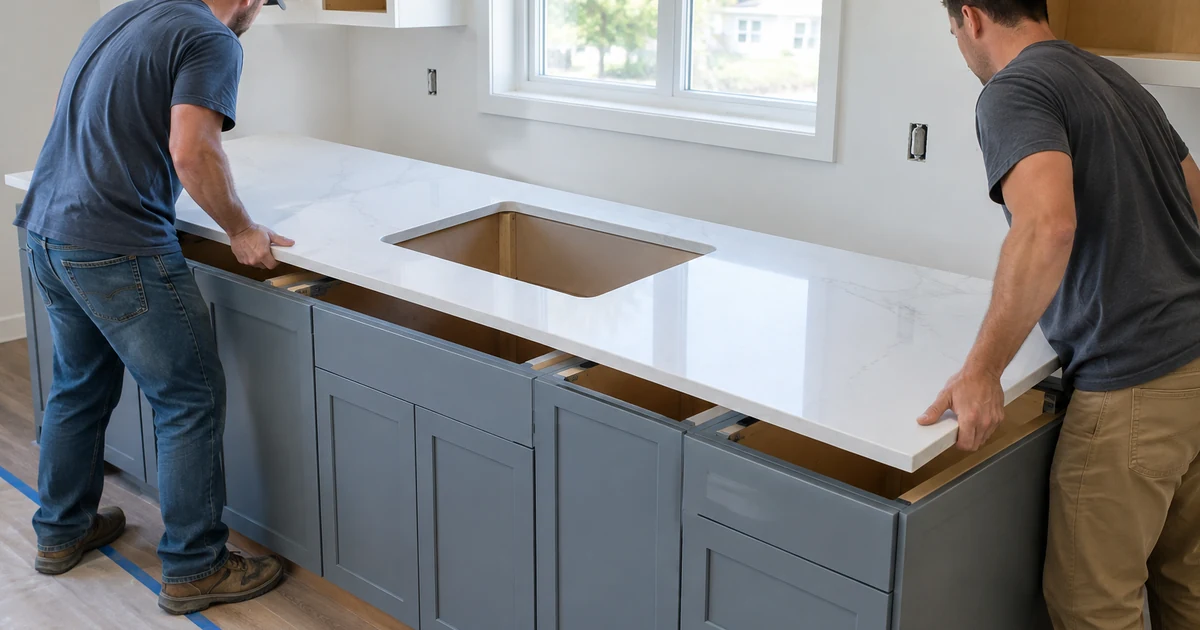
- Installation: the crew sets the pieces, joins and color-matches seams, attaches undermount sinks and seals natural stone. Most kitchens are installed in a day.
- Reconnection: a plumber reconnects the sink, faucet, dishwasher drain and disposal, and stone usually needs to cure before heavy use.
Plan for the sink to be out of service between tear-out and reconnection, often a day or two. Some contractors offer temporary tops if the gap between tear-out and installation is longer.
DIY vs. Hiring a Pro
Laminate, butcher block and some prefabricated tops are realistic DIY projects for a handy homeowner with the right saw and help lifting. You can save most of the $20 to $50 per square foot labor cost, though you’ll spend $100 to $500 or more on tools and supplies, and butcher block must be sealed or oiled before use.
Granite, quartz, marble and quartzite are different. Slabs are heavy, crack easily if lifted wrong, and require wet saws and polishing tools to cut. Most stone suppliers sell only fabricated and installed tops, and some quartz manufacturers’ warranties require installation by an approved fabricator. Cutting, grinding and drilling stone, and engineered quartz in particular, releases respirable crystalline silica dust, which OSHA identifies as a serious lung hazard and expects fabricators to control with wet cutting and dust extraction. Leave any on-site cutting to the pros. Plumbing reconnection is simple for many homeowners, but call a plumber if you’re adding a disposal or moving the sink.
How to Save Money on Countertop Installation
- Choose an entry-level color group. The same material can double in price between the lowest and highest grade.
- Ask about remnants for small jobs like a vanity, laundry counter or small island; leftover pieces from larger jobs are often sold at a discount.
- Stick with a standard edge. Eased or square edges are usually included, while decorative profiles are charged by the linear foot.
- Limit cutouts. Every sink, cooktop and outlet cutout adds cost; a drop-in sink is cheaper to fabricate than undermount.
- Mix materials. Use stone on the main run and butcher block or laminate on a secondary area such as a desk or bar.
- Do the tear-out yourself if it’s laminate on sound cabinets, and confirm the fabricator will deduct it.
- Get three quotes from fabricators that list price per square foot, edge, cutouts, sealing, tear-out and plumbing separately.
If new countertops are part of a bigger kitchen project, see our full kitchen remodel cost guide for how counters fit into the overall budget, and our garbage disposal installation cost guide if you’re adding or replacing a disposal while the sink is out.
Frequently Asked Questions
How much does it cost to install countertops per square foot?
Most installed countertops run $40 to $150 per square foot. Laminate can be as low as $15 to $60, while premium quartz, marble and quartzite can reach $200 per square foot. Labor alone is typically $20 to $50 per square foot.
Is quartz or granite cheaper?
Their ranges overlap heavily. Entry-level granite and builder-grade quartz both start around $40 to $60 per square foot installed, while exotic granite and designer quartz can top $150 to $200. Compare specific color groups rather than materials in general.
Does countertop installation include removing the old countertops?
Not always. Tear-out and disposal typically adds $50 to $600 depending on the old material, so confirm whether it’s included. Many fabricators include it for laminate but charge more for tile or stone.
How long does countertop installation take?
Stone and quartz usually take one to two weeks from templating to installation, and the install itself is often done in a day. Laminate and butcher block can be installed in a few hours if bought pre-made or cut to length.
Can you install new countertops on old cabinets?
Yes, if the cabinets are solid, level and square. Stone is heavy and unforgiving, so sagging or damaged boxes may need reinforcement or replacement first.
What is the cheapest countertop to install?
Laminate is usually the least expensive at roughly $15 to $60 per square foot installed, with some butcher block close behind. Prefabricated laminate and butcher block are also the easiest to install yourself.