Hardwood Floor Installation Cost by Type
The biggest decision is the type of board: engineered or solid, and prefinished at the factory or sanded and finished in your home. Species and plank width come next. The prices below are installed costs per square foot, including standard underlayment and labor, before removal of the old floor.
| Floor type | What it is | Installed (per sq ft) | 500 sq ft installed |
|---|---|---|---|
| Engineered hardwood | Real wood veneer over plywood core; can float, glue, or nail | $5.85–$10.80 | $2,925–$5,400 |
| Solid, prefinished | 3/4 in. solid oak or maple, finish applied at the factory | $6.50–$12.00 | $3,250–$6,000 |
| Solid, site-finished | Unfinished boards sanded, stained, and coated after install | $7.80–$14.40 | $3,900–$7,200 |
| Exotic or wide-plank premium | Brazilian walnut, wide white oak, custom patterns | $11.05–$20.40 | $5,525–$10,200 |
National cost guides put the average hardwood installation between roughly $2,500 and $7,000, and a 500 sq ft project with prefinished solid oak and carpet removal typically lands near $5,000. Sources disagree on per-foot prices: some report $6 to $12 per sq ft for average jobs, others quote $9 to $25, largely because they include more premium species and wider boards. High-end projects past $13 per sq ft are common in expensive metro areas.
Engineered flooring is not a budget product. Good engineered planks with a thick wear layer can cost as much as solid, but they handle humidity swings better and can go over concrete slabs and in basements where solid hardwood is not recommended.
Material cost by wood species
Material prices vary a lot between retailers and grades. These are approximate board-only prices per square foot:
| Species | Material (per sq ft) | Notes |
|---|---|---|
| Pine | $2–$8 | Softwood; dents easily, rustic look |
| Red oak | $3–$10 | Most common US hardwood, takes stain well |
| White oak | $5–$12 | Tighter grain, popular in wide planks |
| Maple | $4–$12 | Hard and smooth; blotchy with dark stains |
| Hickory | $6–$14 | Very hard, strong color variation |
| Brazilian walnut (ipe) | $9–$15 | Exotic, extremely dense, harder to install |
Grade also matters. Rustic or character grades with knots and color variation cost less than clear or select grades from the same species.
Cost by room size
Using prefinished solid hardwood at $6.50 to $12 per sq ft installed, before removal of the existing floor:
| Space | Approx. area | Installed cost |
|---|---|---|
| 10×12 bedroom | 120 sq ft | $780–$1,440 |
| 15×20 living room | 300 sq ft | $1,950–$3,600 |
| Living, dining, and hall | 500 sq ft | $3,250–$6,000 |
| Main floor of a house | 1,000 sq ft | $6,500–$12,000 |
| Whole home | 2,000 sq ft | $13,000–$24,000 |
Larger projects can earn a slightly lower per-foot labor rate, while a single small room may hit an installer’s job minimum. Running the same flooring through connected rooms also avoids thresholds and gives a cleaner look.
Cost Breakdown: Materials vs. Labor
Labor for nail-down hardwood usually runs about $3 to $6 per sq ft, more for wide planks, diagonal layouts, or glue-down over concrete. For a 500 sq ft room with prefinished solid oak:
| Item | Unit cost | 500 sq ft project |
|---|---|---|
| Prefinished oak flooring (550 sq ft incl. 10% waste) | $3.00–$5.50 per sq ft | $1,650–$3,025 |
| Underlayment paper, cleats/staples, transitions | Varies by layout | $100–$350 |
| Installation labor (nail-down) | $3.00–$5.25 per sq ft | $1,500–$2,625 |
| Remove and dispose of old carpet | $0.50–$1.50 per sq ft | $250–$750 |
| Total | $3,500–$6,750 |
With unfinished flooring, the board price drops a little, but sanding, staining, and applying two or three coats of finish on site adds roughly $2 to $7 per sq ft. The payoff is a smooth, sealed surface with no bevels between boards and a custom stain color.
Other Factors That Affect the Price
Removing the existing floor
Pulling carpet and pad is quick. Old hardwood, glued vinyl, or tile take far longer, and removal of those floors commonly runs $1.50 to $3.50 per sq ft, with tile at the top of the range or beyond.
Subfloor repairs
Nail-down hardwood needs a solid, flat plywood or OSB subfloor. Squeaks, soft spots from old leaks, or out-of-level joists must be fixed first. Guides report subfloor repairs anywhere from $900 to $3,000 for a typical project, or about $2.20 to $4.75 per sq ft to replace subfloor sheets outright.
Concrete slabs and basements
Solid hardwood generally is not installed directly on concrete or below grade. Engineered hardwood can be glued down or floated over a moisture barrier, and glue-down labor usually costs more than nailing.
Plank width and pattern
Wide planks (5 inches and up) cost more per foot and need more careful subfloor prep. Herringbone and chevron layouts involve far more cutting; Angi reports patterns like herringbone can add around 30% to the total bill.
Stairs, trim, and transitions
Stair treads are priced per step and require stair nosing and risers, so a staircase can cost as much as a small room. Thresholds, reducers at doorways, and new baseboard or shoe molding also add to the total.
Moving furniture and appliances
Some crews include furniture moving, others charge by the hour, commonly $60 to $120 per hour. Clearing the rooms yourself before install day avoids this charge.
Location
Labor rates in large coastal cities can run well above the national averages shown here. The region selector in the calculator gives a rough adjustment.
Before you hire: get at least three written, itemized quotes from licensed and insured local pros. Prices for the same job often differ by 30% or more, and comparing line items is the fastest way to spot padding or missing work.
Refinish vs. Replace Hardwood Floors
If you already have hardwood under the carpet or in worn condition, refinishing is almost always cheaper than replacing. Traditional sanding and refinishing runs about $3 to $8 per sq ft, and national averages for a refinishing job sit near $1,900.
Refinish when the boards are structurally sound and the damage is surface wear: dull finish, light scratches, faded color, or minor stains. Solid 3/4 inch flooring can be sanded several times over its life.
Replace when boards are cupped or crowned from water damage, soft or rotted, heavily pet-stained deep into the wood, or when engineered flooring has a wear layer too thin to sand again. Small damaged areas can often be patched with matching boards rather than replacing the whole floor.
DIY vs. Hiring a Pro
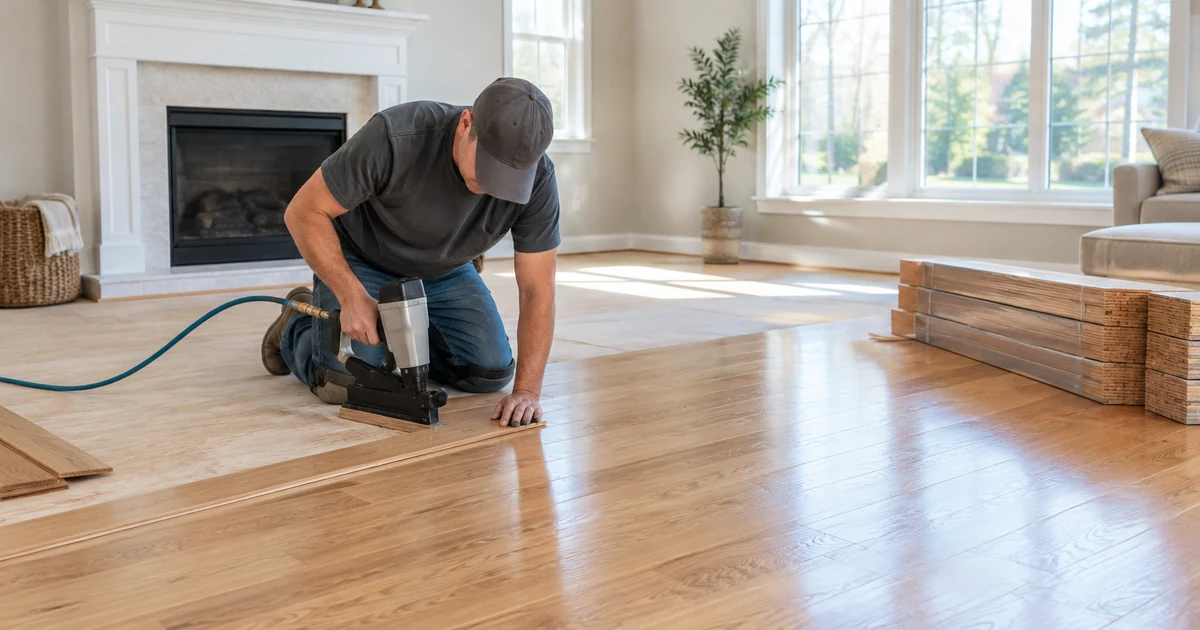
Floating engineered hardwood with a click-lock joint is within reach of an experienced DIYer. Nail-down solid hardwood is a harder job: it requires a flooring nailer, careful layout so the rows stay straight across rooms, and good judgment on expansion gaps and moisture. Sanding and finishing on site is the part most homeowners regret attempting, since a drum sander can gouge a floor in seconds.
Hiring a pro also makes sense for any floor that must match existing hardwood in an adjoining room. Weaving new boards into old ones, matching the species and width, and blending the finish so the seam disappears is detailed work that experienced installers do routinely.
Flooring replacement rarely needs a building permit, but condo associations often require sound-rated underlayment. If the project is part of a larger remodel, check permit rules for the whole job.
For a lower-cost look-alike, compare laminate flooring installation cost and vinyl plank flooring installation cost, both usually well under hardwood per square foot. In bathrooms and entries, tile installation is the more durable choice.
How to Save Money on Hardwood Floor Installation
- Check under the carpet first. Many older homes have oak floors hiding under carpet; refinishing them costs a fraction of new flooring.
- Choose a character or rustic grade. Knots and color variation cost less than clear grades and hide wear better.
- Stay with standard widths. 2-1/4 to 3-1/4 inch strip oak is usually cheaper to buy and install than wide plank.
- Go prefinished. It skips days of on-site sanding and finishing, and the house is usable sooner.
- Do the prep yourself. Tear out carpet, pull tack strips, and move furniture before the crew arrives.
- Buy the right amount. Order about 10% extra for waste on straight layouts; patterns need more.
- Get at least three itemized quotes. Confirm each covers removal, subfloor prep, transitions, and trim so the numbers line up.
Frequently Asked Questions
How much does it cost to install hardwood floors in a 12×12 room?
A 12×12 room is 144 sq ft. At $6.50 to $12 per sq ft installed for prefinished solid oak, expect roughly $950 to $1,750, plus removal of the old floor and any minimum charge for a small job.
Is engineered hardwood cheaper to install than solid?
Often slightly. Engineered planks can float or click together, which cuts labor, and they work over concrete. Premium engineered boards with thick wear layers can cost as much as solid, though.
What is the labor cost to install hardwood floors?
Labor usually runs about $3 to $6 per sq ft for nail-down installation. Wide planks, patterns, glue-down over concrete, and stairs push labor higher, and sanding and finishing unfinished floors adds roughly $2 to $7 per sq ft.
Is it cheaper to refinish or replace hardwood floors?
Refinishing is much cheaper, typically $3 to $8 per sq ft versus $6.50 to $12 or more for new installed flooring. Replacement makes sense only when boards are water-damaged, rotted, or too thin to sand again.
How long does hardwood floor installation take?
A crew can usually install a few hundred square feet of prefinished hardwood per day. Boards typically acclimate in the home for several days first, and site-finished floors need extra days for sanding, staining, and drying between coats.
Can hardwood be installed over concrete?
Solid hardwood generally should not be installed directly on concrete. Engineered hardwood can be glued down or floated over a moisture barrier on a slab, which is the usual choice for basements and slab-on-grade homes.