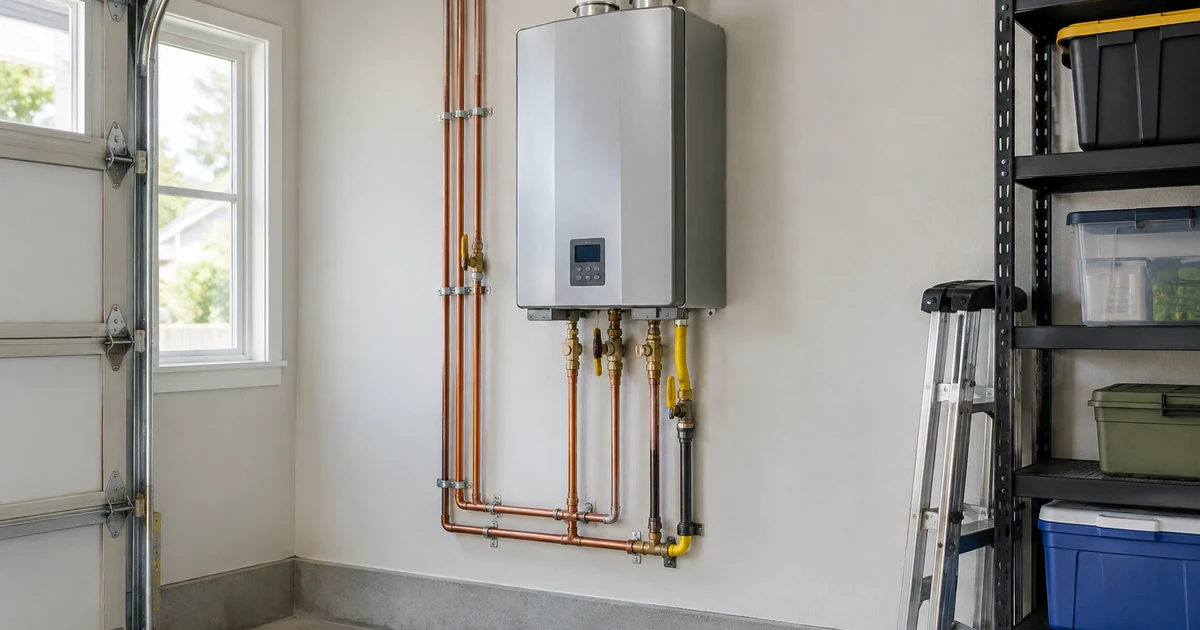
Tankless Water Heater Installation Cost by Fuel Type
Fuel type sets both the equipment price and how much prep work the installer has to do. Electric tankless units are cheaper to buy, but whole-house models draw a lot of power. Gas and propane units cost more and need dedicated venting and an adequately sized gas line.
| Fuel type | Unit only | Installed cost | Main extra work |
|---|---|---|---|
| Electric (whole-house) | $500–$1,500 | $1,400–$3,000 | Dedicated high-amp circuits, possible panel upgrade |
| Propane | $1,000–$2,000 | $1,600–$4,500 | Venting, propane line sizing |
| Natural gas | $1,500–$2,600 | $2,100–$5,600 | Venting, larger gas line, condensate drain |
| Point-of-use (electric) | $150–$500 | $300–$900 | Outlet or circuit at the fixture |
Most homeowners installing a whole-house gas unit pay around $2,700, which lines up with national averages of roughly $2,500 to $2,800 reported by major cost guides. Jobs that need a new gas line, new venting and an electrical upgrade can push past $5,000.
Point-of-use units are small heaters mounted under a sink or near a single shower. They’re a cheap way to fix a far-away bathroom that takes forever to get hot water, but they don’t replace a whole-house system.
Cost by size (flow rate)
Tankless units are sized by gallons per minute (GPM), not tank capacity. The higher the flow rate, the more fixtures you can run at once.
| Flow rate | Typical use | Unit price |
|---|---|---|
| 1–2 GPM | Single sink (point-of-use) | $150–$500 |
| 2–4 GPM | Small home, 1 bathroom | $500–$1,000 |
| 5–7 GPM | 2–3 bathrooms | $1,000–$2,000 |
| 8–10 GPM | Large home, simultaneous showers | $1,500–$3,000 |
In colder regions, incoming groundwater is colder, so a unit delivers fewer gallons per minute at shower temperature. Installers in northern states often size up one step for that reason.
Cost Breakdown: Materials vs. Labor
Unlike a simple tank swap, a tankless install is labor-heavy. The unit is only part of the bill:
- Tankless unit: $500–$2,600 for a whole-house model
- Installation labor: $600–$2,500, depending on whether it’s a straight replacement or a tank-to-tankless conversion (usually 3–8 hours)
- Supplies (valves, venting kit, fittings, isolation valves): $150–$300
- Permit and inspection: $50–$200
- Old tank removal: $75–$500
Plumbers and HVAC technicians typically charge $75 to $150 per hour, and electricians $50 to $130 per hour when circuit work is needed. Most contractors still quote tankless jobs as a flat project price.
Tank-to-Tankless Conversion Costs
Replacing an old tankless unit with a new one is relatively simple because the gas line, venting and electrical are already sized for it. Converting from a tank is where the extra costs appear. Expect some or all of these add-ons:
| Upgrade | Typical cost | When it’s needed |
|---|---|---|
| Gas line upsizing or new gas line | $350–$2,000 | Most gas tankless units need far more gas than a tank heater |
| New venting | $100–$800 | Gas units require dedicated sealed venting |
| New dedicated electrical circuit | $200–$900 | Electric whole-house units, or power for gas-unit controls |
| Electrical panel upgrade | $850–$2,000 | Electric units in homes with small or full panels |
| Relocation of the heater | $150–$3,400 | Moving the unit to a wall or exterior location |
A gas tankless unit may need a larger gas line from the meter than your old tank used. For details on that part of the job, see our guide to gas line installation cost. If you’re going electric and your service is undersized, check the numbers in our electrical panel upgrade cost guide before committing.
Other Factors That Affect the Price
Condensing vs. non-condensing
Condensing gas units are more efficient and can vent with less expensive plastic pipe, but they cost more to buy and need a condensate drain. Non-condensing units are cheaper upfront but typically require stainless steel venting.
Installation location
Mounting the new unit where the old tank sat keeps pipe runs short. Moving it to an outside wall can simplify venting but adds new water and gas lines. Outdoor-rated models avoid venting entirely in mild climates.
Water quality
Hard water scales up heat exchangers. Many installers recommend a water softener or scale-prevention filter, and annual descaling service typically runs $100 to $500 depending on the provider and whether you add filtration.
Permits and code
Nearly all cities require a plumbing permit for tankless installation, and gas or electrical work may need separate permits. Budget $50 to $200 in most areas.
Operating and maintenance costs
The installed price is only part of the lifetime cost. Published estimates put annual energy costs for a gas tankless unit at roughly $190 to $265, versus about $440 to $580 for a conventional tank, though real results depend on local fuel prices and how much hot water your household uses. Propane units generally cost more to run than natural gas.
Plan on descaling at least once a year, more often with hard water. A plumber visit for flushing typically costs $100 to $500 depending on your area and whether filters or a softener are added, or you can do it yourself with a pump kit and white vinegar if the manufacturer allows it.
Number of units
Large homes with far-apart bathrooms sometimes use two whole-house units or one main unit plus point-of-use heaters. Each additional unit adds its own equipment, venting and labor, so a two-unit setup can cost nearly double a single install.
Region
Labor rates in high-cost metros can be 20% to 40% above the national average. Use the region selector in the calculator above to adjust your estimate.
Before you hire: get at least three written, itemized quotes from licensed and insured local pros. Prices for the same job often differ by 30% or more, and comparing line items is the fastest way to spot padding or missing work.
Is a Tankless Water Heater Worth It?
According to the U.S. Department of Energy, tankless heaters can be 24% to 34% more energy efficient than conventional tanks for homes that use about 41 gallons of hot water or less per day. They also last longer, often 15 to 20 years compared with 8 to 12 for a tank.
The trade-off is upfront cost. A tankless system typically costs $1,000 or more beyond a comparable tank replacement, and the annual energy savings are modest, often around $100 per year for gas models according to published estimates. It can take many years to recover the difference, so tankless makes the most sense if you:
- Plan to stay in the home long enough to benefit from the longer lifespan
- Want endless hot water for back-to-back showers or a large soaking tub
- Need to free up floor space in a small utility room or closet
- Already have a large enough gas line or electrical service
If you only want the lowest price today, a standard tank is cheaper. Compare both options in our water heater replacement cost guide.
DIY vs. Hiring a Pro
Tankless installation is not a good DIY project for most homeowners. Gas units involve gas piping, combustion venting and carbon monoxide risks, and electric whole-house units can require multiple high-amperage circuits. Mistakes can be dangerous and are expensive to fix.
Many manufacturers also require licensed installation to honor the warranty, and permits usually have to be pulled by a licensed plumber or electrician. A small point-of-use electric unit that plugs into an existing outlet is the main exception a handy homeowner might tackle.
How to Save Money on Tankless Water Heater Installation
- Get three or more quotes that list the unit model, gas line size, venting type and electrical work separately.
- Size it correctly. Buying a bigger unit than your peak demand wastes money; buying too small leads to cold showers.
- Keep the same location when possible to avoid new pipe and vent runs.
- Check utility and manufacturer rebates. Rebates from utilities and manufacturers are common. The federal 25C tax credit that covered qualifying gas tankless units ended for equipment installed after December 31, 2025, so it no longer applies to 2026 installs.
- Schedule before your old tank fails so you can shop around instead of paying for an emergency install.
- Flush or descale yearly to protect the heat exchanger and keep the warranty valid.
Frequently Asked Questions
How much does it cost to convert from a tank to a tankless water heater?
A tank-to-tankless conversion typically costs $2,500 to $5,600 or more for a gas unit because it often needs new venting and a larger gas line. Electric conversions can be cheaper unless your electrical panel needs an upgrade.
Is a gas or electric tankless water heater cheaper to install?
Electric tankless units are usually cheaper to buy and install, roughly $1,400 to $3,000 total, as long as your panel can handle the load. Gas units cost $2,100 to $5,600 installed but can supply more hot water at once.
How long does a tankless water heater last?
With regular descaling, most tankless water heaters last 15 to 20 years, compared with roughly 8 to 12 years for a standard tank.
How long does tankless water heater installation take?
A straight tankless-for-tankless replacement can take about 3 hours. A conversion from a tank with new venting, gas or electrical work typically takes 4 to 8 hours, and sometimes a second day.
Does a tankless water heater save money?
Tankless units can be 24% to 34% more efficient for homes with modest hot water use, but annual savings are often around $100. The higher installation cost means payback can take many years, so the longer lifespan and endless hot water are usually the bigger benefits.
Can I get a tax credit for a tankless water heater in 2026?
The federal 25C credit, which covered 30% up to $600 for qualifying gas tankless units, ended for equipment placed in service after December 31, 2025. Check your utility and the manufacturer for current rebates.
- HomeGuide — Tankless water heater installation cost
- Angi — How much does a tankless water heater cost
- This Old House — Tankless water heater installation cost
- Bob Vila — Tankless water heater cost
- U.S. Department of Energy — Tankless or demand-type water heaters
- Rewiring America — 25C federal tax credits