Concrete Driveway Cost by Size
Size drives the bill more than anything else, because concrete is priced by the square foot. The table uses a standard 4-inch driveway with a broom or lightly decorative finish, which most contractors price between $8 and $15 per square foot. The “typical” column uses about $9.80 per square foot, the same figure behind the calculator’s default.
| Driveway size | Area | Cost range | Typical |
|---|---|---|---|
| 1-car, 10 x 20 ft | 200 sq ft | $1,600 – $3,000 | $1,960 |
| 1-car, 12 x 24 ft | 288 sq ft | $2,300 – $4,300 | $2,820 |
| 2-car, 20 x 20 ft | 400 sq ft | $3,200 – $6,000 | $3,920 |
| 2-car, 24 x 24 ft | 576 sq ft | $4,600 – $8,600 | $5,650 |
| 2-car, 16 x 40 ft | 640 sq ft | $5,100 – $9,600 | $6,270 |
| 3-car, 24 x 36 ft | 864 sq ft | $6,900 – $13,000 | $8,470 |
Small driveways cost more per square foot than large ones. The crew, the forms, and the concrete truck all show up whether you pour 200 or 800 square feet, and ready-mix suppliers add short-load fees when an order is under a full truck. A single-car pad can easily land at $12 or more per square foot for that reason.
Long rural driveways work the other way. Once you pass 1,000 square feet, the per-foot price often drops toward the low end, although grading and base work usually grow with the length.
Concrete Driveway Cost by Finish
The finish is the second big lever. A plain gray slab is the cheapest surface per square foot, and every decorative step adds labor, specialty tools, or both.
| Finish | Installed cost per sq ft | 600 sq ft driveway |
|---|---|---|
| Plain smooth or trowel | $6 – $8 | $3,600 – $4,800 |
| Broom finish (standard) | $8 – $12 | $4,800 – $7,200 |
| Integral color | $10 – $15 | $6,000 – $9,000 |
| Exposed aggregate | $11 – $17 | $6,600 – $10,200 |
| Stamped, one pattern and color | $12 – $18 | $7,200 – $10,800 |
| Stamped multi-color, stained, or saw-cut designs | $16 – $24+ | $9,600 – $14,400+ |
A broom finish is what most homeowners choose, and for good reason: the texture gives tires and shoes grip in rain and ice, and it hides minor surface flaws. Stamped concrete looks like stone or brick but is more slippery when wet unless the sealer includes a grit additive, and it needs resealing every few years to keep its color.
Cost Breakdown: Materials vs. Labor
Labor and materials split the bill roughly in half. Here is how a standard 4-inch broom-finished driveway breaks down per square foot:
| Item | Cost per sq ft | 600 sq ft driveway |
|---|---|---|
| Ready-mix concrete ($130 – $180 per cubic yard) | $1.60 – $2.40 | $960 – $1,440 |
| Compacted gravel base | $0.50 – $2.00 | $300 – $1,200 |
| Reinforcement (fiber, wire mesh, or rebar grid) | $0.50 – $2.00 | $300 – $1,200 |
| Labor: excavation, forming, pouring, finishing, joints | $3.00 – $7.00 | $1,800 – $4,200 |
| Total | $5.60 – $13.40 | $3,360 – $8,040 |
A 600 sq ft driveway at 4 inches needs about 7.4 cubic yards of concrete, or close to 8 yards once you allow for uneven subgrade and spillage. Our concrete calculator shows the math for any size and thickness.
Other Factors That Affect the Price
Removing the old driveway
Tearing out an existing driveway typically adds $2 to $6 per square foot, or roughly $1,200 to $4,500 for a one- or two-car driveway. Reinforced concrete costs more to break and haul than plain concrete, and asphalt is usually cheaper to remove. Some contractors include demolition in their quote; others list it separately, so ask.
Thickness and reinforcement
Four inches is the standard for passenger cars. If you park an RV, a boat trailer, or a heavy pickup, or if delivery trucks use the driveway, most contractors recommend 5 to 6 inches. Expect a 6-inch slab to cost about 20% to 30% more than a 4-inch slab. Rebar at the edges and at the apron is money well spent on soft or clay soils.
Grading and site prep
A flat lot with firm soil needs little more than excavation and a gravel base. A sloped lot, poor drainage, or tree roots can add $700 to $2,500 in grading, fill, and compaction. Water that pools under a slab is the most common reason concrete driveways crack early, so this is not the place to cut corners.
Apron, curb cut, and permits
Many towns require a permit for a new driveway or a widened curb cut, usually $50 to $200. The apron where the driveway meets the street often has its own specifications for thickness and slope, and a new curb cut or apron can add $1,500 to $4,300 depending on local rules.
Access and pumping
If the ready-mix truck can back up to the forms, the pour is quick. If it can’t, because of a fence, a steep grade, or a septic field the truck must avoid, the crew needs a pump truck or wheelbarrows, and the price rises accordingly.
Location
Labor rates and concrete prices vary by metro area. Driveways in high-cost areas of the Northeast and West Coast often run 20% or more above the national figures shown here, while rural areas of the South and Midwest tend to come in lower.
Before you hire: get at least three written, itemized quotes from licensed and insured local pros. Prices for the same job often differ by 30% or more, and comparing line items is the fastest way to spot padding or missing work.
Repair, Resurface, or Replace?
Not every tired driveway needs a full tear-out. Here is a rough guide:
- Hairline cracks and small chips: crack filler and patching cost little and can be DIY. Professional concrete repairs generally run $3 to $25 per square foot depending on the damage.
- Surface scaling or stains on a sound slab: a resurfacing overlay costs about $3 to $10 per square foot and restores the look without new structure.
- Sunken or heaved sections: slab jacking or foam lifting can raise settled panels if the concrete itself is intact.
- Wide cracks, broken panels across most of the drive, or a failed base: replacement is the better investment, because overlays crack again over a moving base.
DIY vs. Hiring a Pro
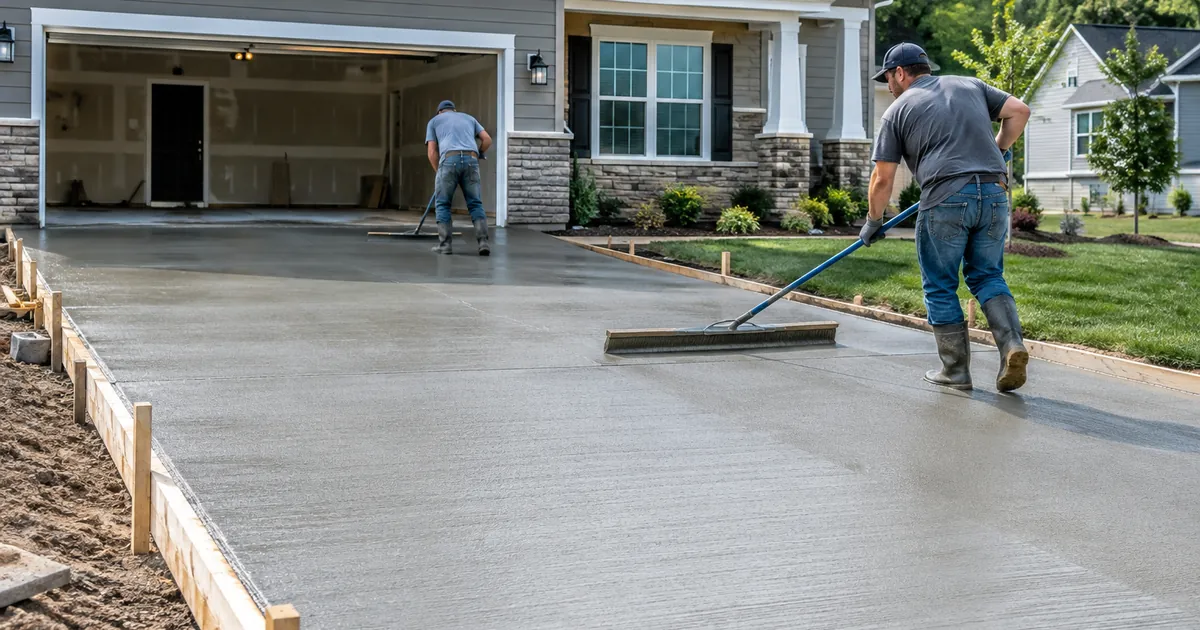
A driveway is one of the harder concrete jobs to do yourself. Once a truck delivers 7 or 8 yards of concrete, you have a limited window, often a couple of hours in warm weather, to spread, screed, float, edge, joint, and finish the entire surface. Most pros bring a crew of three to five people for a two-car driveway.
Handy homeowners can save money by doing the demolition and hauling, or by pouring a small parking pad or walkway. For a full driveway, the risk of a poor finish or misplaced control joints usually outweighs the labor savings. Whoever pours it, keep cars off new concrete for about a week; it keeps gaining strength for roughly 28 days.
How to Save Money on a Concrete Driveway
- Get at least three written quotes with the same specs so you can compare them line by line.
- Choose a broom finish and spend on a decorative border only where it shows, instead of stamping the whole surface.
- Pour other flatwork at the same time. Adding a walkway or small patio to the same pour spreads the setup cost and can help you avoid short-load fees, which run about $40 to $60 per cubic yard on partial truckloads.
- Keep the existing base if it is sound. When a contractor confirms the old gravel base is compacted and well drained, reusing it trims prep costs.
- Do the demo yourself if you have the time and a place to take the rubble; some recycling yards accept clean concrete for a low fee.
- Book outside peak season. Concrete contractors are busiest in late spring and summer; early spring or fall bookings can bring more flexible pricing in many areas.
- Seal it yourself. Sealer costs about $0.50 to $0.75 per square foot in materials if you apply it, versus $1 to $2 per square foot for a pro.
If concrete is over budget, compare the numbers for an asphalt driveway, which typically costs less up front but needs sealcoating, or a gravel driveway, the cheapest surface to install. Planning a backyard slab too? See our concrete patio cost guide.
Frequently Asked Questions
How much does a 24×24 concrete driveway cost?
A 24 x 24 ft driveway is 576 square feet, so it typically costs $4,600 to $8,600 with a standard finish, or about $5,650 at the national midpoint. Stamping or coloring can push it past $10,000.
Is a concrete driveway cheaper than asphalt?
No, concrete usually costs more up front. Asphalt typically runs $5.50 to $11 per square foot versus $8 to $12 for broom-finished concrete. Concrete lasts longer, often 30 years or more, and needs less routine maintenance, so the lifetime cost gap is smaller than the installation gap.
How thick should a concrete driveway be?
Four inches is standard for passenger cars and light SUVs. Go to 5 or 6 inches if you park heavy pickups, RVs, or trailers, or if delivery trucks regularly use the driveway.
How long does a concrete driveway last?
A properly built concrete driveway commonly lasts 30 years or longer. Good drainage, a compacted base, correctly spaced control joints, and periodic sealing in freeze-thaw climates all extend its life.
How soon can I drive on a new concrete driveway?
You can usually walk on it after a day or two, but keep cars off for about seven days. Concrete keeps curing for roughly 28 days, so avoid heavy trucks until then.
Does a concrete driveway need to be sealed?
Sealing is optional for a plain broom finish, but it helps resist de-icing salts, oil stains, and freeze-thaw damage. Stamped and colored concrete should be resealed every few years to protect the color.