Concrete Slab Cost by Thickness
Thickness is the main driver of the price per square foot, because it sets how much concrete you need. A standard 4-inch slab works for patios, walkways and sheds. Garages, driveways and slabs carrying heavy loads usually need 5 to 6 inches, and structural foundations go thicker still.
| Thickness | Installed cost per sq ft | Concrete per 100 sq ft | Common uses |
|---|---|---|---|
| 4 inches | $5–$9 | About 1.2 cu yd | Patios, walkways, shed and AC pads |
| 5 inches | $5.50–$10 | About 1.5 cu yd | Garage floors, light vehicle pads |
| 6 inches | $6–$11 | About 1.9 cu yd | Driveways, RV pads, workshop floors |
| 8 inches+ | $8–$14+ | About 2.5 cu yd | Heavy equipment, structural slabs |
Most national guides land in the same neighborhood. HomeGuide lists $6 to $8 per square foot for a 4-inch slab and $8 to $10 for 6 inches, while LawnStarter’s averages run a little lower at about $5.35 and $6.19. Angi puts the overall average at $4 to $8 per square foot, with thick home foundations reaching $18. Ready-mix concrete itself is often quoted around $110 to $126 per cubic yard before delivery fees, and one cubic yard covers about 81 square feet at 4 inches thick. Use our concrete calculator to work out yardage for your exact dimensions.
Concrete slab cost by size
Size matters almost linearly, with one exception: very small slabs cost more per square foot because of delivery minimums and setup time.
| Slab size | Square feet | 4-inch slab installed |
|---|---|---|
| 10 x 10 | 100 | $500–$1,200 |
| 12 x 12 | 144 | $720–$1,700 |
| 12 x 20 | 240 | $1,200–$2,200 |
| 20 x 20 | 400 | $2,000–$3,600 |
| 24 x 24 | 576 | $2,900–$5,200 |
| 30 x 30 | 900 | $4,500–$8,100 |
| 40 x 40 | 1,600 | $8,000–$14,400 |
A 20 x 20 slab, about the size of a two-car garage floor or a large patio, is the most common job, and most homeowners pay around $2,700 for one at 4 inches thick on a level site.
Concrete Slab Cost by Use
What the slab is for decides its thickness, reinforcement and base, so the same footprint can carry very different prices.
| Project | Typical size | Typical installed cost |
|---|---|---|
| Shed foundation | 80–200 sq ft | $480–$2,000 |
| Patio (plain broom finish) | 200–400 sq ft | $1,200–$4,000 |
| Garage floor (2-car) | 400–576 sq ft | $2,400–$6,900 |
| Driveway | 400–600 sq ft | $2,400–$8,600 |
| RV pad | 200–700 sq ft | $1,200–$8,400 |
| Home addition or house slab foundation | 400–2,400 sq ft | $6–$14+ per sq ft |
Garage floors usually call for 5 to 6 inches, reinforcement, a vapor barrier and sometimes thickened edges, which is why they cost more per square foot than a patio. A slab for a house or room addition is a structural foundation with footings, inspections and often plumbing rough-ins under it, so it’s priced well above a simple flatwork slab. For decorative outdoor slabs, see our concrete patio cost guide, and for vehicle surfaces our concrete driveway cost guide.
Cost Breakdown: Materials vs. Labor
For a plain slab, materials and labor are roughly balanced. HomeGuide estimates materials at $3 to $7 per square foot and labor at $3 to $5, with labor making up about 40% to 50% of the total. Angi puts labor alone at $2 to $3 per square foot.
| Item | Typical cost |
|---|---|
| Ready-mix concrete | About $110–$126 per cu yd, plus delivery and short-load fees |
| Gravel base (4–6 inches) | $1–$3 per sq ft |
| Wire mesh | About $0.35 per sq ft |
| Rebar grid | $0.50–$3 per sq ft |
| Fiber-reinforced mix | Adds roughly $2–$3 per sq ft |
| Vapor barrier | About $0.50 per sq ft |
| Thickened edges | $1–$2 per sq ft |
| Forming, pouring and finishing labor | $2–$5 per sq ft |
Reinforcement options
Welded wire mesh is the low-cost standard for patios and sheds and helps hold cracks together. Rebar laid in a grid adds more strength and is common for garage floors, driveways and anything carrying vehicles. Fiber-reinforced concrete mixes small fibers into the concrete to reduce shrinkage cracking; it often supplements mesh or rebar rather than replacing it on structural work. Your local code or engineer may specify which one you need.
What a slab installation quote should include
Most concrete contractors follow the same sequence for a new slab. Knowing it makes it easier to compare bids line by line and spot what a cheap quote leaves out:
- Marking the layout, calling utility locating services and removing sod, topsoil or old concrete.
- Grading and compacting the subgrade so the slab won’t settle unevenly.
- Placing and compacting a gravel base, typically 4 to 6 inches deep.
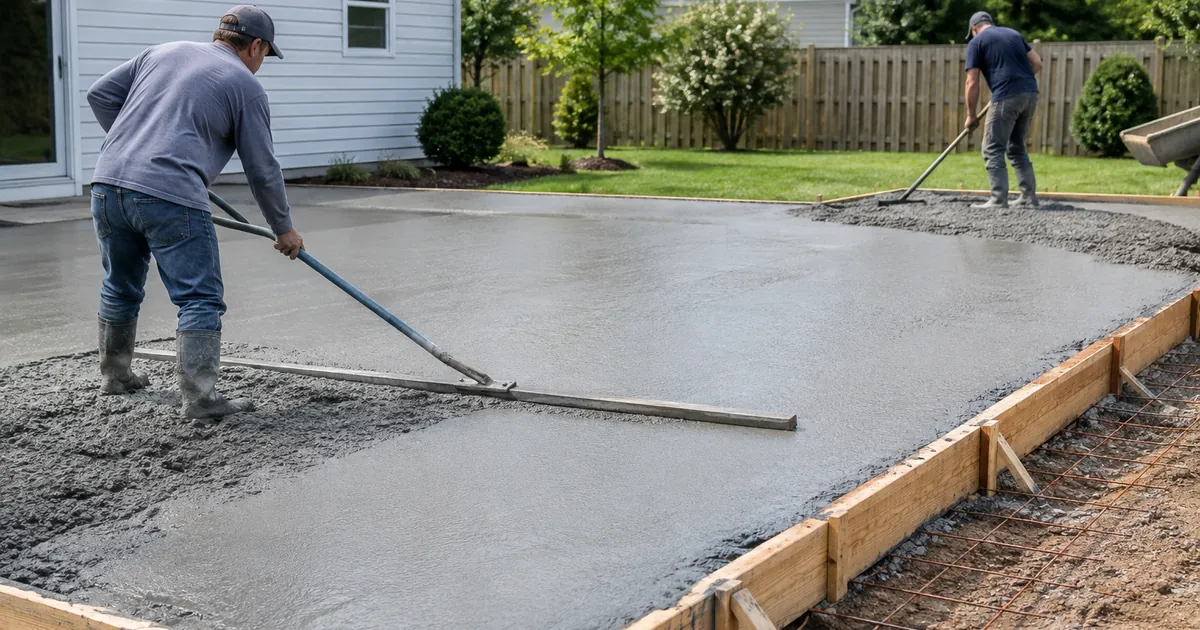
- Building wood or metal forms to the finished height, with a slight slope for drainage on outdoor slabs.
- Laying a vapor barrier where needed, then wire mesh or rebar set on supports so it sits in the middle of the slab.
- Pouring, screeding and floating the concrete, then applying the finish.
- Cutting or tooling control joints, curing the slab and stripping the forms.
If one bid is far below the others, it often skips the gravel base, the vapor barrier or proper reinforcement. Those shortcuts are hard to see once the concrete is down, but they show up later as cracks, settling or moisture coming through a garage or shed floor.
Concrete slab vs. other bases
A slab isn’t the only option for small structures. A compacted gravel pad costs roughly $1 to $3 per square foot and drains well, which makes it a popular base for sheds. Pavers cost more, around $10 to $17 per square foot for a hot tub base, but can be lifted and reset. Concrete costs more than gravel up front, yet gives the flattest, most durable surface and is usually required for garages, heavy equipment and structures attached to the house.
Other Factors That Affect the Price
Site prep and grading
A flat, open spot with firm soil is cheapest. Leveling or regrading typically adds $0.40 to $2 per square foot, and sloped yards may need retaining forms, extra fill or a stepped design. Removing sod and topsoil and compacting the subgrade is part of every quality job.
Removing an old slab
Breaking out and hauling away existing concrete usually costs $3 to $8 per square foot, or roughly $300 to $800 for a 10 x 10 slab. Thicker or heavily reinforced slabs cost more to remove.
Access
If a ready-mix truck can back up to the forms, the pour goes fast. Backyards behind fences or houses may need a concrete pump, a conveyor or wheelbarrows, all of which add labor and equipment charges.
Finish
A broom or smooth trowel finish is usually included. Upgrades add real money: stamped concrete runs about $8 to $19 per square foot installed, exposed aggregate $7 to $15, and staining or polishing $3 to $15. Garage floors are often coated later; see our epoxy garage floor cost guide.
Permits and inspections
Many cities don’t require a permit for a small patio or shed pad, but garage slabs, additions and house foundations almost always need one, along with inspections before the pour. Fees vary by city and project value.
Region and season
Concrete and labor prices vary by state. Angi’s regional data shows slab costs near $5.20 to $5.90 per square foot in parts of the South and Midwest and $7.70 to $8.50 in California. Cold-weather pours may need blankets, heated water or accelerators, which add cost.
Concrete Pad Cost for Small Projects
A concrete pad is simply a small slab, usually for equipment or a single structure. Because a ready-mix truck charges a short-load fee for small orders and crews have a minimum charge, small pads cost more per square foot than large slabs. Expect many contractors to quote a minimum job of several hundred dollars no matter how small the pad is.
| Pad type | Typical size | Typical installed cost |
|---|---|---|
| AC condenser or heat pump pad (poured) | 3 x 3 to 4 x 4 ft | $150–$400 (often minimum-charge pricing) |
| Generator or equipment pad | 3 x 5 to 5 x 5 ft | $150–$500 |
| Hot tub pad | 8 x 8 to 10 x 10 ft | $500–$2,500 |
| Shed pad | 8 x 10 to 12 x 16 ft | $480–$2,000 |
| Parking or trash-can pad | 10 x 20 ft | $1,200–$2,000 |
For an AC unit, many HVAC installers use a precast or plastic equipment pad instead of pouring concrete. A 36 x 36 inch plastic condenser pad sells for around $50 at home centers, so a poured pad mostly makes sense when you’re already pouring other concrete or want a larger, longer-lasting base. If you’re replacing the system at the same time, the pad is usually part of the AC replacement quote.
Hot tub pads deserve extra attention because a filled tub is very heavy. HomeGuide prices concrete hot tub pads at $500 to $2,500 and notes that most spas need a dedicated electrical circuit, which is cheapest to run in a trench before the pad is poured. Check the tub maker’s requirements for slab thickness and levelness before you hire.
Before you hire: get at least three written, itemized quotes from licensed and insured local pros. Prices for the same job often differ by 30% or more, and comparing line items is the fastest way to spot padding or missing work.
DIY vs. Hiring a Pro
A handy homeowner can pour a small pad of a few bags of concrete and save the minimum labor charge. Larger slabs are a different matter. Concrete starts setting quickly, and a 20 x 20 slab needs about 5 cubic yards placed, leveled and finished within a short window, which usually takes a crew of three or four people with screeds, floats and power trowels.
Mistakes are expensive to undo: poor base compaction leads to settling, missing control joints lead to random cracks, and a bad finish can’t be fixed without resurfacing or replacement. For garage floors, driveways and anything structural, hire an experienced concrete contractor who handles permits, base prep and reinforcement to code.
How to Save Money on a Concrete Slab
- Combine small pours. Pour the shed pad, AC pad and walkway on the same day to avoid multiple short-load fees and minimum charges.
- Pick the right thickness. Don’t pay for 6 inches where 4 inches meets code and the intended use.
- Do the demolition or sod removal yourself if you have the time, and confirm the contractor will accept the site as prepared.
- Choose a broom finish now and add stain or a coating later if your budget allows.
- Get three written quotes that list thickness, base depth, reinforcement type, vapor barrier and finish so you compare like with like.
- Schedule in spring or fall. Mild weather avoids cold-weather additives and summer peak demand.
- Use a plastic AC pad instead of a poured pad when the only goal is a level base for an outdoor unit.
Frequently Asked Questions
How much does a 20×20 concrete slab cost?
A 400 sq ft, 4-inch slab typically costs $2,000 to $3,600 installed, with most around $2,700. Making it 6 inches thick with rebar for a garage or vehicle use pushes the price to roughly $2,600 to $4,800.
How much does a concrete pad cost?
Small pads cost more per square foot because of short-load fees and minimum charges. A poured AC pad often runs $150 to $400, a hot tub pad $500 to $2,500 and a shed pad about $480 to $2,000, depending on size and access.
How thick should a concrete slab be?
Four inches is standard for patios, walkways and sheds. Garage floors and driveways usually use 5 to 6 inches, and slabs for heavy equipment or structures can be 8 inches or more. Follow local code and your contractor’s or engineer’s specification.
Is it cheaper to pour your own concrete slab?
DIY can save roughly $2 to $5 per square foot in labor on a small pad. Large slabs need a crew to place and finish several cubic yards before the concrete sets, so mistakes can cost more than the labor you save.
How many yards of concrete do I need for a slab?
One cubic yard covers about 81 square feet at 4 inches thick. A 20×20 slab at 4 inches needs roughly 5 cubic yards; order about 5% to 10% extra for waste and uneven subgrade.
Do I need a permit for a concrete slab?
Small patios and shed pads often don’t need a permit, but garage slabs, home additions and house foundations almost always do. Rules vary by city, so check with your local building department.