Use the calculator above as a quick cost to build a house calculator: enter your planned square footage, pick a finish level and region, and add your lot price if you’re buying land. It estimates the house itself plus optional site work, which is how most builders quote.
Cost to Build a House per Square Foot
Square footage times a realistic cost per square foot is how builders, lenders and appraisers frame a new home budget. The rate depends mostly on the finish level you choose and the builder you hire. The figures below cover the house itself and exclude the lot.
| Finish level | Cost per sq ft | 2,000 sq ft home | What you typically get |
|---|---|---|---|
| Basic / entry-level | $120–$200 | $240,000–$400,000 | Simple plan, vinyl siding, laminate counters, builder-grade fixtures |
| Mid-range (most common) | $150–$260 | $300,000–$520,000 | Upgraded flooring, quartz or granite, better windows and cabinets |
| Custom | $240–$420 | $480,000–$840,000 | Architect-designed plan, more complex roofline, premium finishes |
| Luxury | $330–$550+ | $660,000–$1,100,000+ | High-end materials, specialty systems, extensive millwork |
Most homeowners building a mid-range home pay roughly $200 per square foot for the structure, which puts a typical 2,000 sq ft house around $400,000 before land. Published averages vary: Angi reports $150 per square foot as the most common figure, HomeGuide puts builder-grade homes at $180 to $280, and custom work commonly runs $200 to $550 per square foot. Sources differ because some include site work, design fees and builder profit and others don’t.
What builders actually spend
The National Association of Home Builders (NAHB) surveys its members on real construction budgets. In its 2024 survey, the average construction cost was $162 per square foot, or $428,215 for an average home of 2,647 square feet, the highest per-foot figure in the survey’s history. That number is the builder’s hard cost only. In the same survey, builder overhead and general expenses added 5.7% of the sales price and profit another 11%, which is why the price a homeowner pays for a contract build usually lands above $162 per square foot.
The U.S. Census Bureau reports a similar picture from the other side of the contract: the median contract price for contractor-built single-family homes started in 2025 was $404,000, excluding the lot.
Cost to Build a House by Size
Size is the other half of the equation. Most new single-family homes are a little over 2,100 square feet at the median, according to Census data. Here’s what common sizes cost at the mid-range rate, excluding land:
| Home size | Typical range | Typical cost (about $200/sq ft) |
|---|---|---|
| 1,000 sq ft | $150,000–$300,000 | $200,000 |
| 1,500 sq ft | $225,000–$450,000 | $300,000 |
| 2,000 sq ft | $300,000–$600,000 | $400,000 |
| 2,500 sq ft | $375,000–$750,000 | $500,000 |
| 3,000 sq ft | $450,000–$900,000 | $600,000 |
Cost doesn’t scale perfectly with size. Kitchens, bathrooms and mechanical systems are expensive no matter how big the house is, so a small home often costs more per square foot than a larger one with the same finishes. Adding plain square footage, such as a bigger bonus room, is usually the cheapest space you can build.
1,500 sq ft example
A 1,500 sq ft three-bedroom ranch with mid-range finishes typically costs $225,000 to $450,000, with many projects near $300,000. Single-story homes need more foundation and roof per square foot of living space, so they can run slightly higher per foot than a two-story of the same size.
2,000 sq ft example
A 2,000 sq ft home is close to the national median for new construction. At about $200 per square foot it costs around $400,000 to build, with a realistic range of $300,000 to $600,000 depending on finishes and location. Add land, site work and utility connections if you’re starting from a raw lot.
2,500 sq ft example
A 2,500 sq ft four-bedroom home typically costs $375,000 to $750,000, with about $500,000 typical for mid-range finishes. Building up instead of out helps here: a second story generally costs 10% to 30% less per square foot than spreading the same space across one level, because the foundation and roof are shared.
Cost Breakdown by Construction Phase
The NAHB survey breaks construction costs into eight stages. The table applies those shares to a $400,000 mid-range build so you can see where the money goes.
| Phase | Share of construction cost | On a $400,000 build | Main items |
|---|---|---|---|
| Site work | 7.6% | $30,400 | Permits, impact fees, water/sewer fees, plans and engineering |
| Foundation | 10.5% | $42,000 | Excavation, concrete, backfill, retaining walls |
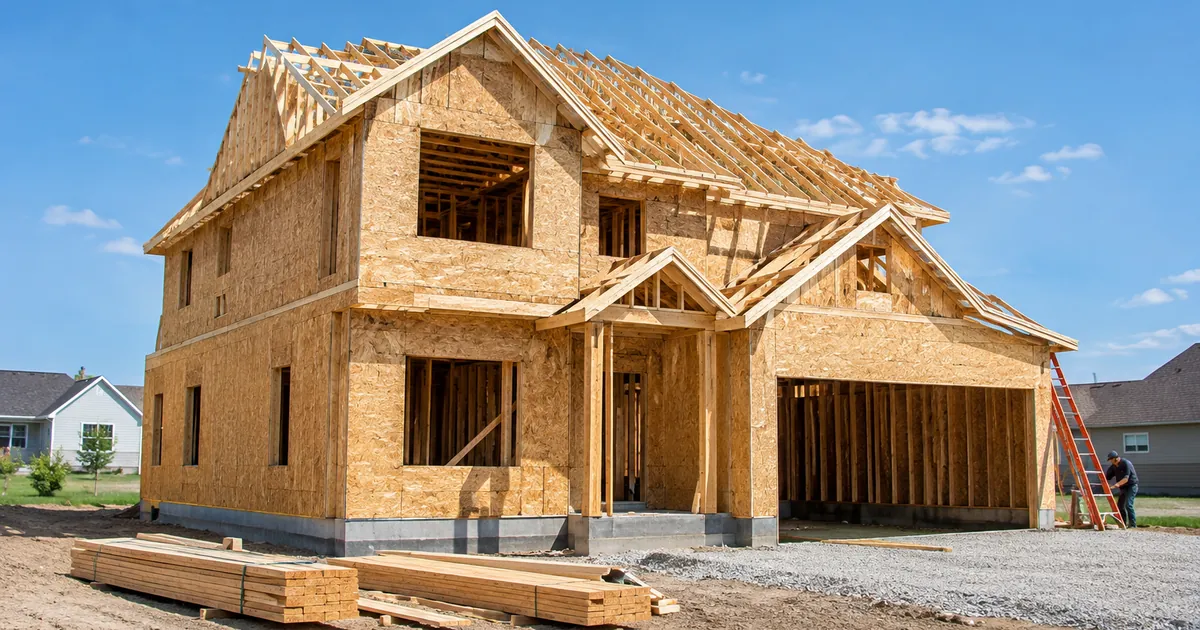
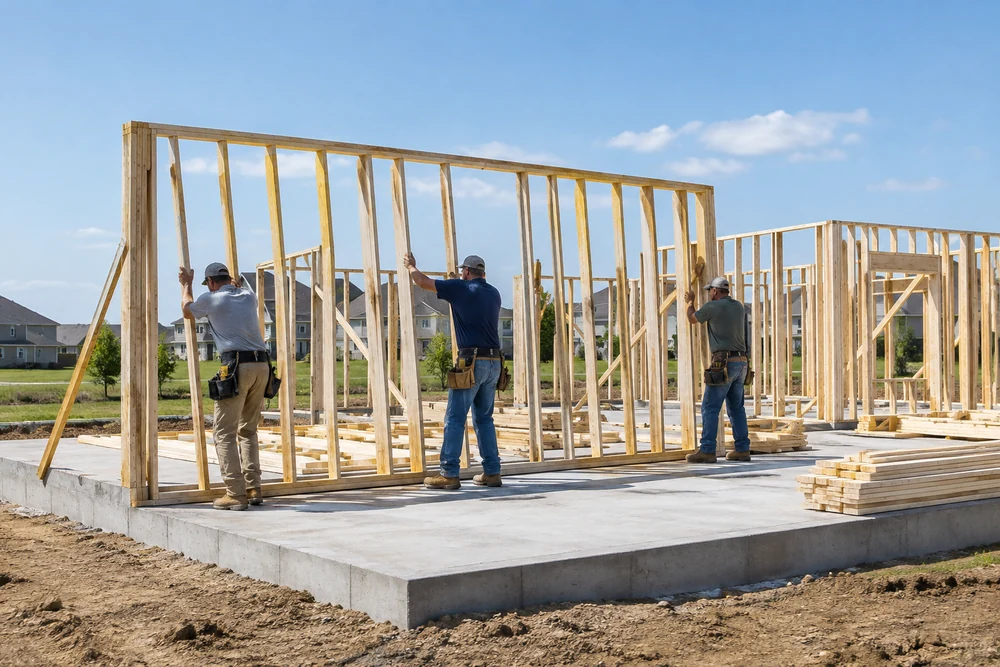
| Framing | 16.6% | $66,400 | Lumber, trusses, sheathing |
| Exterior finishes | 13.4% | $53,600 | Siding, roofing, windows and doors |
| Major systems rough-in | 19.2% | $76,800 | Plumbing, electrical, HVAC |
| Interior finishes | 24.1% | $96,400 | Drywall, insulation, cabinets, counters, flooring, paint, fixtures, appliances |
| Final steps | 6.5% | $26,000 | Driveway, landscaping, decks or patios, cleanup |
| Other | 2.1% | $8,400 | Miscellaneous |
Interior finishes are the largest single phase and the one you control most. Cabinets and countertops alone averaged about $19,000 in the NAHB survey, and flooring about $15,400. Choosing mid-range rather than premium finishes is the most effective way to keep a budget on track. For a sense of how finish choices move the price, our kitchen remodel cost guide shows how much cabinets and counters vary between grades.
Cost Breakdown: Materials vs. Labor
Labor typically makes up 30% to 50% of the cost to build a house, and materials the remaining 50% to 70%. Labor shares are higher in expensive metro areas and on custom homes with complex details.
- General contractor fee: often built into the price as overhead and profit; Angi puts general contractor costs at roughly $32,000 to $64,000 on a typical home
- Framing labor and materials: $35,000 to $75,000 on a typical home, with lumber prices a major swing factor
- Electrical, plumbing and HVAC: each commonly $8,000 to $20,000 or more, depending on the size of the house and system choices
- Roofing: about $10,000 to $25,000+
- Windows and doors: about $16,000 to $50,000
- Insulation and drywall: about $12,000 to $40,000
- Appliances: about $3,100 to $7,700 for a standard package, $15,000+ for high-end
Land, Permits and Site Preparation
The figures above cover the house. If you don’t already own a buildable lot, land and site work can add tens of thousands of dollars or more, and they vary more than any other part of the budget.
Land
Rural acreage can cost as little as $8,000 to $15,000 per acre in some areas, while residential lots in developed neighborhoods commonly run $30,000 to $100,000 or more. In the NAHB survey, the average finished lot cost $91,057 and represented 13.7% of a new home’s sales price. In high-cost coastal markets, the lot alone can exceed the cost of the house.
Permits and fees
A basic residential building permit can cost $500 to $2,000 in many areas, but total government fees are often much higher. Builders in the NAHB survey reported averaging $7,640 in building permit fees, $6,367 in impact fees and $6,260 in water and sewer fees and inspections. Your local building department can give you exact numbers before you buy a lot.
Site preparation
Clearing, grading and excavation typically cost $5,000 to $20,000 or more. Land clearing alone runs about $1,400 to $6,200, grading $1,000 to $3,300 and a survey $1,800 to $6,500. Steep, rocky or wooded lots sit at the top of those ranges.
Utilities
Connecting water, sewer, power and gas typically costs $9,000 to $34,500 or more, and a long run from the road can push it higher. A raw rural lot may need a well and septic system instead; see our guides to septic tank cost and well pump cost for those components. A lot that already has utilities at the street can save $6,500 to $30,000.
Design and engineering
Stock house plans cost about $500 to $5,000. A custom design runs roughly $5,000 to $20,000 for simpler homes, and a full-service architect on a custom home can charge $10,000 to $60,000. A structural engineer typically adds $2,000 to $10,000.
Before you hire: get at least three written, itemized quotes from licensed and insured local pros. Prices for the same job often differ by 30% or more, and comparing line items is the fastest way to spot padding or missing work.
Custom vs. Production Builder
Who builds your home changes the price as much as what you build. There are three common routes:
Production (tract) builders
Production builders build many homes from a set of floor plans, usually in a planned community where they’ve already developed the lots. Buying materials in volume and repeating the same plans keeps costs down. You choose from a menu of options and upgrades rather than designing from scratch. This is generally the lowest-cost way to get a new home, though upgrades can add up fast.
Semi-custom builders
Semi-custom builders start from their own plan library but allow changes to layouts, elevations and finishes, often on your lot or one they sell. Expect to pay more per square foot than a production home, with more flexibility.
Custom builders
A custom builder constructs a one-off design, typically drawn by an architect, on land you own. Custom homes commonly run $200 to $550 per square foot because every detail is specified individually and nothing is mass-produced. You get full control over the layout and finishes, but you also make hundreds of decisions, and changes during construction add cost and time.
| Builder type | Relative cost | Design control | Typical timeline |
|---|---|---|---|
| Production | Lowest | Pick from set plans and option packages | Shortest |
| Semi-custom | Moderate | Modify a builder plan | Moderate |
| Custom | Highest | Fully custom design | Longest |
Fixed-price vs. cost-plus contracts
Builders usually quote either a fixed price, which sets the total up front and puts the risk of overruns on the builder, or a cost-plus contract, where you pay actual costs plus a fee or percentage. Fixed-price contracts are easier to budget. Cost-plus can be fair on complex custom homes but requires closer tracking of invoices. Either way, read how allowances for items like flooring and fixtures are set, since low allowances are a common source of surprise costs.
Other Factors That Affect the Price
Location
Labor rates, code requirements and fees differ widely by region. NAHB’s analysis of 2024 Census data shows median square-foot prices for contractor-built homes, excluding the lot:
| Region (Census division) | Median price per sq ft, contractor-built |
|---|---|
| New England | Over $190 |
| Middle Atlantic | $188 |
| East North Central (Great Lakes) | $186 |
| Mountain | $169 |
| Pacific | $167 |
| West South Central (TX, OK, LA, AR) | $138 |
| East South Central (KY, TN, AL, MS) | $129 or lower |
| National median | $166 |
These medians reflect a mix of finish levels and are lower than full contract prices in expensive metros, but the pattern holds: New England and the Mid-Atlantic cost the most, and the South Central states the least. Use the region selector in the calculator to adjust for your area.
Foundation type
A slab-on-grade foundation is the least expensive. Crawl spaces cost more, and a full basement costs the most but adds usable or storage space below the house. Soil conditions, a high water table or a sloped lot can add significantly to foundation costs. Use our concrete calculator to estimate slab and footing volumes.
Shape and roofline
A simple rectangle with a straightforward gable roof is the cheapest shape to build. Every extra corner, bump-out, dormer and roof valley adds framing, flashing and labor.
Number of bathrooms and kitchen size
Bathrooms and kitchens concentrate plumbing, electrical, tile, cabinets and fixtures into a small area, so they are the most expensive rooms per square foot. Each additional bedroom can add $20,000 to $80,000 or more once you account for the bathroom, closets and extra space that usually come with it.
Energy features
Heat pumps, extra insulation, high-performance windows and solar panels raise upfront cost but reduce operating costs. Note that the federal 25C and 25D residential energy tax credits ended for property placed in service after December 31, 2025, so don’t count on them for a 2026 build. Some utilities and states still offer incentives; check with yours before choosing equipment.
Market conditions
Lumber, concrete and labor costs move with the market. NAHB notes that ongoing shortages of construction labor have pushed up wage growth in homebuilding, which shows up in bids. Ask builders how long their price is valid and whether material escalation clauses apply.
Build vs. Buy
Building can cost more than buying an existing home of the same size, especially once land, site work and the time spent living elsewhere during construction are included; temporary housing alone can run $8,600 to $11,900. In exchange you get a new home with modern systems, energy efficiency and a layout you chose, plus fewer repairs in the first years.
Before you commit, budget for an independent inspection during construction as well as at completion. A third-party inspector can catch framing, flashing or insulation problems before they’re covered up; see our home inspection cost guide for typical fees.
How to Save Money Building a House
- Use a stock or builder plan. Pre-drawn plans can save 10% to 25% compared with a fully custom design.
- Keep the footprint simple. A rectangular plan with a simple roof costs less than one with many corners and valleys.
- Build up, not out. A two-story home shares foundation and roof costs across more living space.
- Buy a lot with utilities in place. It can save $6,500 to $30,000 compared with raw land.
- Spend on structure, save on finishes. Insulation, windows and framing are hard to upgrade later; light fixtures, paint and some flooring are easy.
- Lock in allowances. Make sure allowances in the contract match the products you actually want.
- Get at least three detailed bids on the same plans and specifications so you compare like with like.
Frequently Asked Questions
How much does it cost to build a 2,000 sq ft house?
At about $200 per square foot for mid-range finishes, a 2,000 sq ft house costs around $400,000 to build, with a realistic range of $300,000 to $600,000. Land, site preparation and utility connections are extra.
Is it cheaper to build or buy a house?
Buying an existing home is often cheaper upfront, especially once land, site work and temporary housing are included. Building can make sense if you want a specific layout, new systems and fewer near-term repairs, or if comparable homes are scarce in your area.
How much does it cost to build a house per square foot?
Most new homes cost $150 to $300 per square foot to build, excluding land. NAHB’s 2024 survey put builders’ hard construction cost at $162 per square foot, and custom homes commonly run $200 to $550 per square foot.
What is the most expensive part of building a house?
Interior finishes are the largest phase, at about 24% of construction cost in the NAHB survey, followed by plumbing, electrical and HVAC rough-ins at about 19% and framing at about 17%. Land can exceed all of these in expensive markets.
How much does land add to the cost of building a house?
Residential lots commonly cost $30,000 to $100,000 or more, and the average finished lot in NAHB’s 2024 survey was $91,057. Raw land can be cheaper per acre but often needs $5,000 to $20,000+ in site preparation and $9,000 to $34,500+ for utility connections.
Does the cost to build a house include land?
Usually not. Builder quotes and per-square-foot figures cover the house only. Land, clearing, grading and utility connections are separate and vary widely by location.
How accurate is a cost to build a house calculator?
A calculator gives a realistic starting budget based on size, finish level and region. Actual bids depend on your plans, lot conditions and local fees, so get detailed quotes from builders before committing.