Garage Door Replacement Cost by Size and Material
Size and material do most of the work in setting the price. A double door has roughly twice the panel area of a single, and the jump from steel to wood or glass can double the bill again. The table below shows installed prices for a polystyrene-insulated door with removal of the old one, which is how most replacements are quoted.
| Material | Single (9×7) | Double (16×7) | Oversize (18×8+) |
|---|---|---|---|
| Steel | $800–$2,150 | $1,200–$3,050 | $1,700–$4,650 |
| Aluminum | $840–$2,260 | $1,260–$3,200 | $1,790–$4,880 |
| Vinyl or fiberglass | $1,040–$2,800 | $1,560–$3,970 | $2,210–$6,050 |
| Composite (faux wood) | $1,280–$3,440 | $1,920–$4,880 | $2,720–$7,440 |
| Real wood | $1,600–$4,300 | $2,400–$6,100 | $3,400–$9,300 |
| Glass / full-view | $1,920–$5,160 | $2,880–$7,320 | $4,080–$11,160 |
For the most common job, a 16×7 insulated steel door, most homeowners pay about $1,200 to $3,050, and a typical figure is close to $2,000. That lines up with HomeGuide’s $1,000 to $3,500 for an installed double door and Fixr’s $700 to $3,500 for a double steel door. Angi’s lower $1,231 national average reflects the many basic single and non-insulated doors in its data.
Steel dominates the market because it’s durable, low-maintenance, and comes in embossed wood-grain textures. Aluminum is lighter and rust-resistant, which makes it common near the coast and for modern glass designs. Composite doors mimic stained wood without the refinishing, and real wood carriage-house doors are the premium choice for curb appeal.
Two single doors vs. one double door
A two-car garage with two separate openings needs two doors, two sets of springs and tracks, and often two openers. Angi puts two-single-door setups at about $1,200 to $4,900, compared with $800 to $5,000 for one double door. If the center post is load-bearing, converting to a single wide opening requires a new header and usually a permit.
Insulated vs. Non-Insulated Garage Doors
Insulation is the other big line item. Doors come in three basic builds:
| Construction | Typical R-value | Double door installed | Best for |
|---|---|---|---|
| Single-layer steel, non-insulated | None | $1,050–$2,600 | Detached garages, mild climates |
| Steel with polystyrene core | About R-6 to R-9 | $1,200–$3,050 | Most attached garages |
| Steel with injected polyurethane | About R-12 to R-18 | $1,400–$3,500 | Heated garages, rooms above the garage, cold or hot climates |
Polyurethane foam is bonded to both steel skins, so these doors are also stiffer, quieter, and more dent-resistant. If you have a bedroom over the garage or use the space as a workshop, the extra few hundred dollars is usually worth it.
Garage Door Styles and What They Cost
Style affects price mostly through how much material and detail goes into each panel. HomeGuide puts the door alone at roughly $400 to $1,400 for standard panel designs and $800 to $3,500 for glass roll-up and French-style doors, before installation.
- Raised or short panel: the classic suburban look and the least expensive style. Almost every manufacturer stocks it in steel in standard sizes.
- Carriage house: designed to look like swing-out barn doors while operating as a normal sectional door. Expect to pay more for overlays, decorative hardware, and window tops, especially in composite or wood.
- Flush or modern: smooth, flat panels, often in painted steel, aluminum, or wood-look finishes. Pricing ranges from budget steel to high-end architectural lines.
- Full-view glass: aluminum frames with tempered, frosted, or insulated glass. These are the most expensive standard option and need more frequent cleaning, but they bring a lot of light into the garage.
Color can matter too. Stock white and almond usually cost the least, while custom colors, wood-grain finishes, and factory stains add to the price and lead time.
Cost Breakdown: Materials vs. Labor
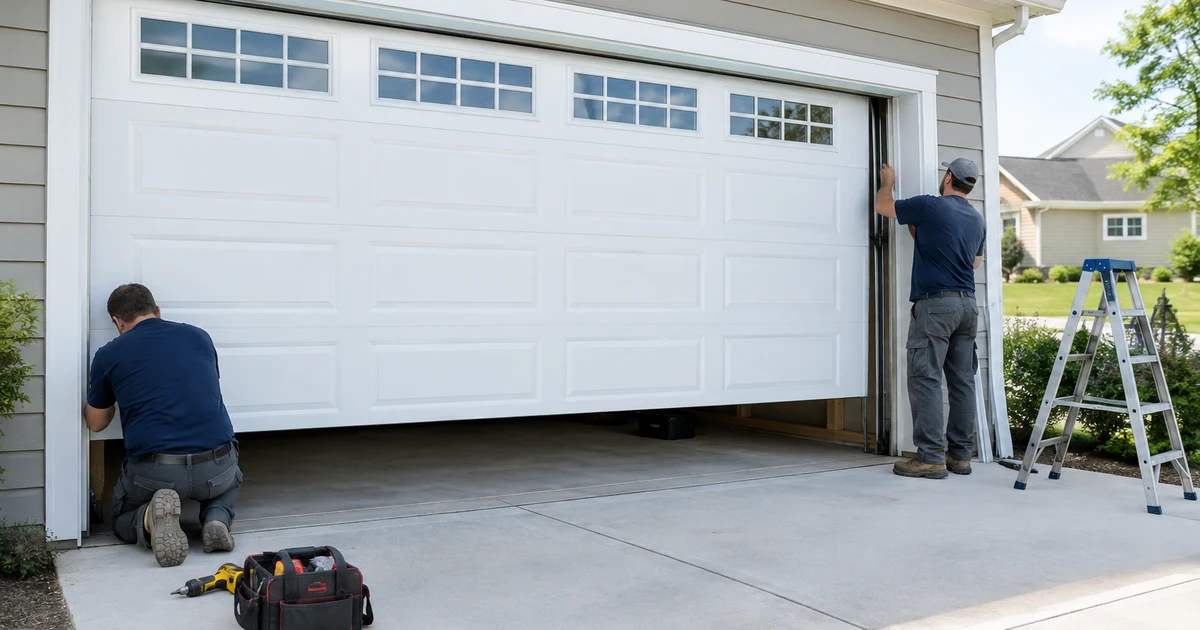
The door itself is most of the bill. Professional installers typically quote a package that includes the door, new tracks, springs, weatherstripping, and hardware.
- Door and hardware: $400 to $2,500 for most residential doors, more for wood, glass, and custom sizes.
- Installation labor: about $200 to $500. Fixr puts single-door installs at $100 to $300 and double doors at $375 to $575.
- Old door removal and disposal: $50 to $250.
- Permit, where required: about $40 to $250.
- New opener (optional): $300 to $900 installed; see our garage door opener installation cost guide.
- Painting or staining (optional): $100 to $700.
Installers usually finish a standard replacement in one day. Because torsion springs are replaced with the door, you also get a fresh spring cycle rating, which is worth something if your old springs were near the end of their life.
Other Factors That Affect Garage Door Cost
Windows and decorative hardware
A row of windows or carriage-house handles and hinges is one of the cheapest ways to dress up a plain steel door. Angi lists windows at roughly $50 to $500 each, depending on glass type and whether they’re insulated or decorative.
Wind load and impact ratings
In hurricane-prone areas such as Florida and much of the Gulf and Atlantic coasts, building codes require wind-rated doors with added bracing. These doors cost more and must match the design pressure on your permit, so get quotes from installers who work in your county.
Custom sizes
Standard sizes like 8×7, 9×7, and 16×7 are stocked and cheapest. Taller 8-foot doors, 18-foot widths, and non-standard openings often need to be built to order, which adds cost and lead time.
Framing and jamb repairs
Rotted wood jambs or a damaged header need to be fixed before a new door goes in. Angi estimates structural repairs at about $155 to $380, though serious rot can cost more.
Region and access
Labor rates in large metro areas run higher than in rural markets. Tight side clearance, low headroom, or a garage with a finished ceiling may require low-headroom track kits and extra time. Use the calculator’s region setting to adjust.
Before you hire: get at least three written, itemized quotes from licensed and insured local pros. Prices for the same job often differ by 30% or more, and comparing line items is the fastest way to spot padding or missing work.
Repair or Replace Your Garage Door?
Many garage door problems are fixable. A broken spring, frayed cable, or noisy roller is a repair, not a reason to replace the whole door. Our garage door spring replacement cost and garage door repair cost guides cover those jobs.
HomeGuide puts typical garage door repairs at about $150 to $350 and single panel replacement at $300 to $1,200 or more. Most doors last 15 to 30 years, so a door approaching that age with multiple problems is usually a better candidate for replacement than for another round of repairs.
Replacement makes more sense when:
- Several panels are dented, cracked, or rusted through, and matching panels are discontinued.
- The door is uninsulated and the garage is attached, heated, or has living space above it.
- The door is heavy, older wood that needs frequent refinishing.
- Repair quotes approach half the cost of a new door.
- You’re preparing to sell. The 2025 Cost vs. Value report ranked garage door replacement as the top project for resale return, with an estimated job cost of about $4,672 and roughly 268% of that cost recouped.
Can you install a garage door yourself?
Sectional doors are sold as DIY kits, but the torsion springs that counterbalance the door are wound under high tension and cause serious injuries every year. Most manufacturers recommend professional installation, and some warranties require it. Since labor is only a few hundred dollars of a $2,000 job, hiring a pro is the sensible choice for most homeowners.
How to Save Money on Garage Door Replacement
- Stick to standard sizes. Stock 9×7 and 16×7 doors are the cheapest to buy and the fastest to get.
- Choose insulated steel over wood. Embossed wood-grain steel or composite gives a similar look for far less money and no refinishing.
- Keep your opener if it works. A healthy opener can usually be reused, though the installer should check that it can handle the new door’s weight.
- Get three quotes that list the same door model so you can compare labor and removal fees fairly.
- Ask about end-of-season or discontinued colors. Dealers sometimes discount overstock doors in standard sizes.
- Bundle work. If you need a new door and an opener, installing both in one visit avoids a second service charge.
Frequently Asked Questions
How much does it cost to replace a double garage door?
A 16×7 double garage door typically costs $1,200 to $3,050 installed in insulated steel, with about $2,000 being common. Wood, composite, and glass doors of the same size usually run $2,000 to $7,000 or more.
How much does a single garage door replacement cost?
A single 8×7 or 9×7 insulated steel door usually costs $800 to $2,150 installed. Non-insulated steel can come in under $700, while wood or glass singles often run $1,600 to $5,000.
Is an insulated garage door worth it?
For attached garages, heated workshops, or garages with living space above, yes. An insulated door typically adds a few hundred dollars, keeps the garage closer to indoor temperature, and is stiffer and quieter than a single-layer door.
Does a new garage door include an opener?
Usually not. Most quotes cover the door, tracks, springs, and hardware only. A new opener adds about $300 to $900 installed, though a working opener can often be reused.
How long does it take to replace a garage door?
A professional crew usually removes the old door and installs a standard replacement in 4 to 6 hours. Custom or oversize doors, framing repairs, and opener installation can stretch the job to a full day or longer.
Does a new garage door add value to a home?
It is one of the best-returning exterior projects. The 2025 Cost vs. Value report estimated that a garage door replacement costing about $4,672 recouped roughly 268% of its cost at resale.
How long does a garage door last?
Most garage doors last 15 to 30 years depending on material, climate, and maintenance. Springs, rollers, and openers usually wear out sooner and can be replaced on their own.