How to Use This Roofing Calculator
The calculator turns four inputs into a price: the size of your roof as seen from above, how steep it is, how cut up it is, and the material you want. Behind the scenes it converts your footprint into true roof surface, adds a waste allowance, and multiplies by an installed price per square foot. The default setting (a 1,700 sq ft footprint, 6/12 pitch, simple gable, architectural shingles with tear-off) comes out to roughly 21 roofing squares and about $12,000.
- Enter your roof footprint in square feet, including the overhangs (method below).
- Pick your roof pitch. The calculator applies the matching pitch multiplier.
- Pick your roof shape so it adds the right amount of waste.
- Choose a material and whether the old roof must be torn off.
- Select your region to adjust for local labor rates.
How to Measure Your Roof Footprint
The footprint is the area your roof covers when you look straight down on it, overhangs included. You can measure it without climbing a ladder.
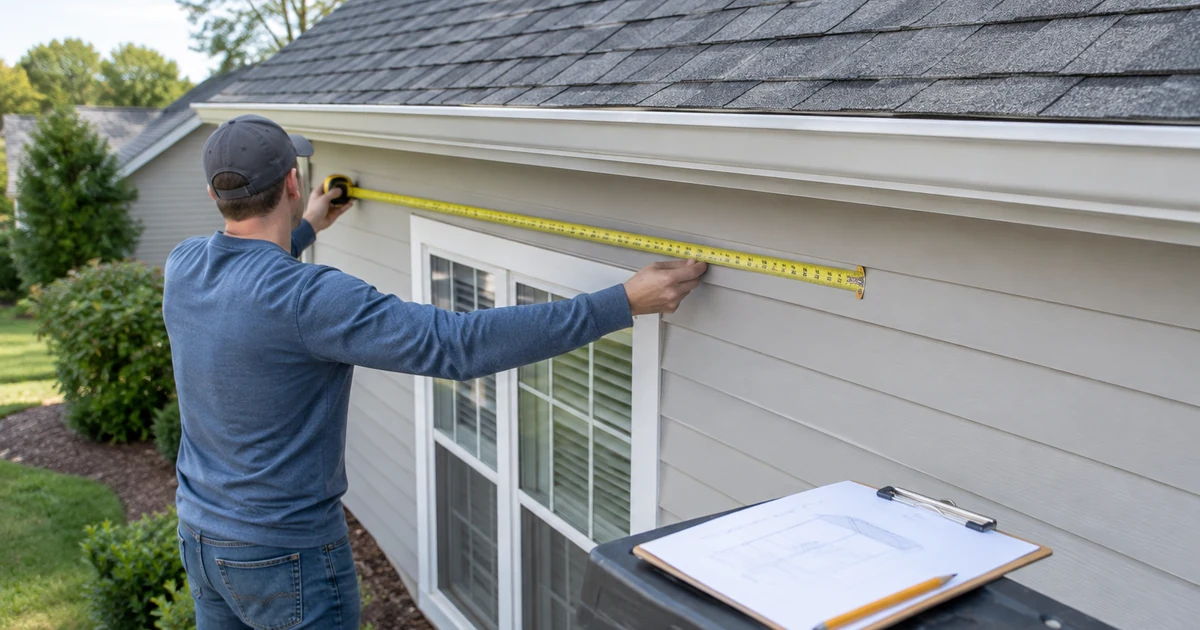
- Measure the house at ground level. Run a tape along each exterior wall and sketch the outline on paper. Split L-shapes and wings into rectangles.
- Add the overhangs. Eaves usually extend 12 to 24 inches past the walls. Measure one from the ground, then add twice that amount to each length and width (once for each side).
- Multiply length by width for each rectangle and add them together. Include the garage and covered porches if they share the roof.
- Cross-check with a satellite view. Free map tools with an area-measuring feature let you trace the roof outline from above. The result should be within a few percent of your tape measurements.
Example: a 40 x 36 ft house with 18-inch overhangs becomes 43 x 39 ft, or 1,677 sq ft of footprint. An attached 12 x 20 ft porch roof adds 240 sq ft for a total of 1,917 sq ft.
Roof Pitch Multipliers
Pitch is the rise in inches for every 12 inches of horizontal run. A steeper roof has more surface over the same footprint, so the footprint is multiplied by a pitch factor. The factor comes straight from geometry: the square root of 1 plus (rise ÷ 12) squared.
| Pitch | Angle | Multiplier | 1,500 sq ft footprint becomes |
|---|---|---|---|
| 3/12 | 14.0° | 1.031 | 1,547 sq ft |
| 4/12 | 18.4° | 1.054 | 1,581 sq ft |
| 5/12 | 22.6° | 1.083 | 1,625 sq ft |
| 6/12 | 26.6° | 1.118 | 1,677 sq ft |
| 7/12 | 30.3° | 1.158 | 1,737 sq ft |
| 8/12 | 33.7° | 1.202 | 1,803 sq ft |
| 9/12 | 36.9° | 1.250 | 1,875 sq ft |
| 10/12 | 39.8° | 1.302 | 1,953 sq ft |
| 12/12 | 45.0° | 1.414 | 2,121 sq ft |
How to find your pitch
From inside the attic, hold a level horizontally against the underside of a rafter, mark 12 inches along the level, and measure straight up from that mark to the rafter. That vertical distance in inches is the rise. From outside, a smartphone level app held against the rake board (the sloped trim at the gable end) gives the angle, which you can match to the table above. Most American homes fall between 4/12 and 9/12.
Asphalt shingles need a pitch of at least 2/12, and between 2/12 and 4/12 manufacturers require extra underlayment. Anything flatter needs a membrane such as TPO or EPDM.
Roofing Squares and Waste Factor
Roofers order and price material by the square, which equals 100 sq ft of roof surface. Divide the roof area by 100, then add waste for trimming at edges, hips, and valleys. Starter strip and ridge cap come on top of the field shingles.
| Roof shape | Typical waste allowance | Why |
|---|---|---|
| Simple gable (two flat planes) | 10% | Few angled cuts; mostly full shingles |
| Hip roof | 12% – 15% | Every hip needs angled cuts on both sides |
| Hips, valleys, and dormers | 15% – 20% | Many short courses and offcuts |
| Very cut-up roof (turrets, many levels) | 18% – 22% | Lots of small, unusable pieces |
Worked example: 1,700 sq ft footprint x 1.118 (6/12 pitch) = 1,901 sq ft of roof. Add 10% for a gable roof: 2,091 sq ft, or about 21 squares. For architectural shingles packaged three bundles per square, that’s 63 bundles of field shingles, plus starter and ridge cap.
Roofing Cost per Square Foot by Material
The calculator multiplies your squares by these installed prices. They cover materials and labor for the new roof. Tear-off is a separate line at about $1.00 to $2.00 per sq ft for one layer of shingles.
| Material | Installed per sq ft | Installed per square |
|---|---|---|
| 3-tab asphalt shingles | $3.00 – $4.50 | $300 – $450 |
| Architectural asphalt shingles | $3.50 – $5.50 | $350 – $550 |
| Premium / impact-resistant asphalt | $5.00 – $8.00 | $500 – $800 |
| Flat roof membrane (TPO, EPDM, mod-bit) | $3.50 – $10.00 | $350 – $1,000 |
| Exposed-fastener metal panels | $5.00 – $12.00 | $500 – $1,200 |
| Standing seam metal | $9.00 – $16.00 | $900 – $1,600 |
| Concrete tile | $7.00 – $15.00 | $700 – $1,500 |
| Clay tile | $10.00 – $25.00 | $1,000 – $2,500 |
| Natural slate | $10.00 – $30.00 | $1,000 – $3,000 |
For full project pricing by material and house size, including permits, decking, and what’s in a typical quote, see our roof replacement cost guide. If you’re leaning toward steel or aluminum, the metal roof cost guide breaks down panel styles and metals.
Cost Breakdown: Materials vs. Labor
For an architectural shingle roof, a typical $450 to $750 per square (with tear-off) splits roughly like this:
- Materials: $150 to $250 per square for shingles, synthetic underlayment, starter, ridge cap, drip edge, nails, and vents.
- Installation labor: $200 to $300 per square.
- Tear-off and disposal: $100 to $200 per square for one layer.
If you only need a material list for a DIY shed or garage, multiply your squares by the materials line alone. For a house, the labor share usually makes up 40% to 60% of the total.
What a Roofing Calculator Can’t See
An online estimate is a starting point. These items only show up once a roofer inspects the roof or opens it up.
Decking condition
Rotted plywood or plank sheathing is replaced as found, at roughly $2 to $5 per sq ft. A roof with a history of leaks is more likely to need it.
Steep-slope labor
The pitch multiplier accounts for extra area, not extra effort. Above about 8/12, crews need harnesses and roof jacks and move more slowly, and many roofers add $1,000 to $3,000 to the job.
Flashing and penetrations
Chimneys, skylights, walls, plumbing vents, and exhaust fans each need flashing. Reflashing a chimney or replacing a skylight adds to the per-square price.
Extra layers
Two layers of old shingles, or heavy tile and slate, cost more to strip and haul. Expect $150 to $500 per square for removal in those cases.
Permits and code items
Most towns require a roofing permit, usually $100 to $500. Code-required ice barrier, drip edge, and ventilation can add material the old roof didn’t have.
Before you hire: get at least three written, itemized quotes from licensed and insured local pros. Prices for the same job often differ by 30% or more, and comparing line items is the fastest way to spot padding or missing work.
Measuring It Yourself vs. a Professional Measurement
A ground-level measurement plus a pitch multiplier usually gets you within 5% to 10% of a roofer’s number, which is close enough to set a budget and spot a quote that looks inflated. Don’t climb onto the roof to measure; the tape and satellite method above is safer and almost as accurate.
Before you sign a contract, ask each roofer how many squares they measured and what waste factor they used. Many contractors order aerial measurement reports that list every plane, ridge, and valley. If two quotes differ by several squares on the same house, ask why before comparing prices.
How to Save Money on Your Roof Estimate
- Compare quotes by the square. Divide each total by the squares quoted so you can see whether a difference comes from price or from measurement.
- Challenge oversized waste factors. A simple gable roof rarely needs more than 10% to 12% waste.
- Ask for a per-sheet decking price in writing, so hidden rot doesn’t become an open-ended charge.
- Check whether you actually need a replacement. If damage is limited to one area, compare against our roof repair cost guide first.
- Schedule outside the spring and summer rush when your climate allows, and avoid the weeks right after a major storm.
- Review your insurance policy if hail or wind caused the damage. Covered storm damage may pay for much of the job minus your deductible.
Frequently Asked Questions
How do I calculate how many squares my roof is?
Measure the roof footprint including overhangs, multiply it by the pitch multiplier (1.118 for a 6/12 roof), add 10% to 20% for waste depending on the roof shape, and divide by 100. A 1,700 sq ft footprint at 6/12 with 10% waste is about 21 squares.
How many bundles of shingles are in a square?
Most architectural and 3-tab asphalt shingles come three bundles to a square, so each bundle covers about 33 sq ft. Some heavier designer shingles need four or five bundles per square, so check the wrapper.
What is a roof pitch multiplier?
It’s the factor that converts flat footprint area into actual sloped roof surface. It equals the square root of 1 plus (rise ÷ 12) squared: 1.054 for 4/12, 1.118 for 6/12, 1.202 for 8/12, and 1.414 for 12/12.
Can I measure my roof from Google Maps?
Yes, you can trace the roof outline in a satellite map tool to get the footprint, overhangs included. You still need the pitch, which you can measure from the attic or a gable end, and then apply the pitch multiplier and waste allowance.
How accurate is an online roofing calculator?
With a careful footprint and the right pitch, the square count is usually within 5% to 10% of a roofer’s measurement. The price is less precise, because decking repairs, flashing, steep-slope labor, and local rates only show up in a real quote.
How much waste should I add for roofing?
About 10% for a simple gable roof, 12% to 15% for a hip roof, and 15% to 20% for roofs with many valleys and dormers. Starter strip and ridge cap are calculated separately from the ridges and eaves.