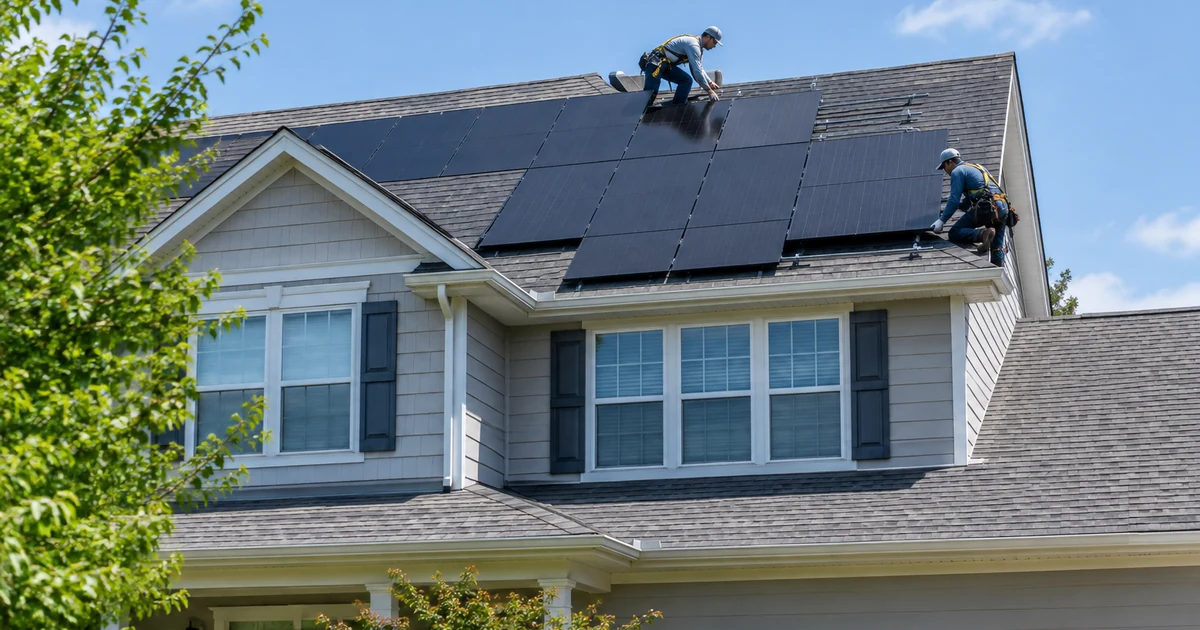
Solar Panel Installation Cost by System Size
Solar is priced per watt of capacity, so the size of the system you need is the first number to pin down. That depends on how much electricity you use, how much sun your roof gets and how much of your bill you want to offset. Your utility bills list annual kWh use, which an installer converts into a recommended system size.
| System size | Approx. panels (400 W) | Typical cost before incentives |
|---|---|---|
| 4 kW | 10 | $9,200–$14,000 |
| 6 kW | 15 | $13,800–$21,000 |
| 8 kW | 20 | $18,400–$28,000 |
| 10 kW | 25 | $23,000–$35,000 |
| 12 kW | 30 | $27,600–$42,000 |
These figures use a consensus range of about $2.30 to $3.50 per watt. EnergySage reports a national average of $2.60 per watt before incentives in mid-2026, with state averages from about $2.27 per watt in Arizona to $3.82 in Alabama. Solar.com cites a national benchmark of $3.36 per watt, and Angi’s project data puts the average installation at about $27,100, with most between $18,300 and $36,400.
Larger systems cost less per watt because permitting, design and sales overhead are spread across more panels. EnergySage’s data shows $2.89 per watt for a 4 kW system versus $2.47 for 15 kW.
How to estimate the system size you need
Start with your annual electricity use in kWh from the last 12 months of bills. Divide it by how many kWh one kW of panels produces per year in your area; that figure is much higher in sunny Southwestern states than in the cloudy Northwest or Northeast. NREL’s free PVWatts calculator estimates production for your address, roof angle and direction.
For example, a home using 10,800 kWh a year in an area where each kW produces about 1,200 kWh would need roughly a 9 kW system to cover all of its use. Shading, roof orientation and your utility’s export credit rules may make a smaller system the better financial choice.
Is There Still a Federal Solar Tax Credit in 2026?
Not for systems homeowners buy and install in 2026. The federal Residential Clean Energy Credit (Section 25D), which covered 30% of the cost of home solar, was ended by 2025 legislation, the One Big Beautiful Bill Act. According to the IRS, the credit isn’t available for property placed in service after December 31, 2025, and it’s claimed for the year the system is installed, not the year it was purchased or contracted.
That means a homeowner-owned system completed in 2026 has no federal credit, and the gross price above is also the starting point for your net cost. Many cost guides and installer websites still show the 30% credit because their pages were written earlier, so check the date on anything you read.
What still lowers the net cost
- State incentives: some states offer tax credits, rebates or sales and property tax exemptions for solar.
- Utility programs: some utilities pay rebates or performance-based incentives, and compensation for excess power sent to the grid (net metering or export credits) varies widely.
- Solar renewable energy credits (SRECs): in a few states, owners can sell credits for the power their system produces.
The DSIRE database (dsireusa.org), run by N.C. State University’s clean energy center, lists state and utility incentives by location.
Leases and power purchase agreements
With a lease or power purchase agreement (PPA), a solar company owns the system on your roof and you pay a monthly amount or a per-kWh rate. The owner may be able to claim business energy tax credits that aren’t available to homeowners, and those programs have their own rules and deadlines. Whether any of that benefit shows up in your price depends on the contract. Leases and PPAs usually mean little or no upfront cost, but you don’t own the system, and they can complicate selling your home. Read the escalator clause, contract length and transfer terms carefully.
Cost Breakdown: Equipment vs. Labor
The panels themselves are a surprisingly small part of the price. Solar.com’s breakdown of a typical system:
| Component | Share of cost | Approx. per watt |
|---|---|---|
| Solar panels | ~11% | ~$0.37 |
| Inverter(s) | ~12% | ~$0.40 |
| Racking and electrical hardware | ~18% | ~$0.60 |
| Installation labor | ~8% | ~$0.27 |
| Permits and inspections | ~3% | ~$0.10 |
| Soft costs (sales, design, overhead) | ~48% | ~$1.61 |
Because soft costs are such a large share, quotes for the same size system can differ by thousands of dollars. That’s why comparing price per watt across several installers matters more than comparing panel brands.
Other Factors That Affect the Price
Roof type and condition
Composition shingle roofs are the easiest to mount on. Tile, slate, metal and flat roofs need special flashing or racking. If your roof is near the end of its life, replace it first; removing and reinstalling panels later adds cost. See our roof replacement cost guide.
Roof-mounted vs. ground-mounted
Ground mounts need footings, trenching and more racking, so they cost more than rooftop arrays. They make sense when the roof is shaded, too small or facing the wrong direction.
Inverter type and equipment quality
A single string inverter is the least expensive. Microinverters or power optimizers cost more but handle partial shading better and allow panel-level monitoring. Premium high-efficiency panels raise the price per watt but produce more power from limited roof space.
Electrical upgrades
Older homes with 100-amp service or a full breaker box may need an electrical panel upgrade before solar can be connected, typically adding $1,300 to $4,000.
Battery storage
Batteries let you store solar power for evenings or outages. Solar.com puts home battery systems at $10,000 to $20,000. Where utilities pay little for exported power, a battery can increase how much of your solar you use yourself. For outage backup alone, compare with a standby generator.
Location
Local labor rates, permitting requirements and competition among installers all affect price per watt, which is why state averages differ by more than a dollar per watt.
Before you hire: get at least three written, itemized quotes from licensed and insured local pros. Prices for the same job often differ by 30% or more, and comparing line items is the fastest way to spot padding or missing work.
DIY vs. Hiring a Pro
DIY solar kits exist, and Angi lists them at roughly $6,000 to $12,000. Doing it yourself removes labor and some soft costs, but it’s a demanding project: working on a roof, structural attachment, high-voltage DC wiring, a permit, inspections and a utility interconnection agreement. Many utilities require a licensed electrician to make the final connection, and some equipment warranties require certified installation. For most homeowners, a licensed installer is the safer route.
Is Solar Worth It Without the Federal Credit?
It depends on local conditions. Payback is fastest where electricity rates are high, the sun is strong, and the utility credits exported power at or near retail rates. Before the federal credit ended, cost guides commonly cited payback periods of roughly 6 to 12 years; without the 30% credit, a purchased system needs more years to recover its cost unless state or utility incentives make up the difference. Ask each installer for a production estimate and a savings projection based on your actual rate plan, and check their assumptions about future rate increases.
How to Save Money on Solar Panel Installation
- Get at least three quotes, including a local installer, and compare price per watt with the same equipment class.
- Look up state and utility incentives before signing; some rebates require pre-approval.
- Cut usage first. Efficiency upgrades reduce the system size you need, and every kW you don’t buy saves roughly $2,300 to $3,500.
- Right-size the system. Where export credits are low, oversizing may not pay off.
- Time it with roof work. Installing on a new roof avoids paying to remove and reinstall panels later.
- Pay cash or compare loan terms. Dealer-arranged loans can include fees built into the price; ask for the cash price too.
- Read lease and PPA terms closely if you go that route, especially price escalators and what happens when you sell.
Frequently Asked Questions
Can I still get the 30% federal solar tax credit in 2026?
Not for a system you own that is placed in service in 2026. The IRS says the Residential Clean Energy Credit isn’t available for property placed in service after December 31, 2025, following the 2025 One Big Beautiful Bill Act. Systems installed by the end of 2025 could still qualify on that year’s return.
How much do solar panels cost for a 2,000 sq ft house?
Home size matters less than electricity use. Typical residential systems in major cost guides range from about 6 kW to 12 kW, which works out to roughly $14,000 to $42,000 before incentives at $2.30 to $3.50 per watt. An installer can size the system from your past 12 months of bills.
What is a good price per watt for solar?
National averages in 2026 range from about $2.60 per watt (EnergySage) to about $3.36 per watt (Solar.com benchmark). A quote near or below the average for your state is generally competitive, but compare equipment, production estimates and warranties too.
Is leasing solar panels cheaper than buying?
A lease or PPA usually costs little or nothing upfront, and the solar company owns the system. Buying costs more upfront but typically saves more over the system’s life if you stay in the home. Lease terms, escalators and transfer rules vary, so compare total costs over the contract.
How long do solar panels last?
Panels commonly carry 20- to 25-year performance warranties, while inverters are typically warrantied for 10 to 15 years and may need replacement during the life of the panels.
Do solar panels increase home value?
Owned systems are generally seen as a plus by buyers, and Angi cites home value increases of about 3% to 5%. Leased systems can complicate a sale because the buyer must take over or buy out the contract.