Ceiling Fan Installation Cost by Job Type
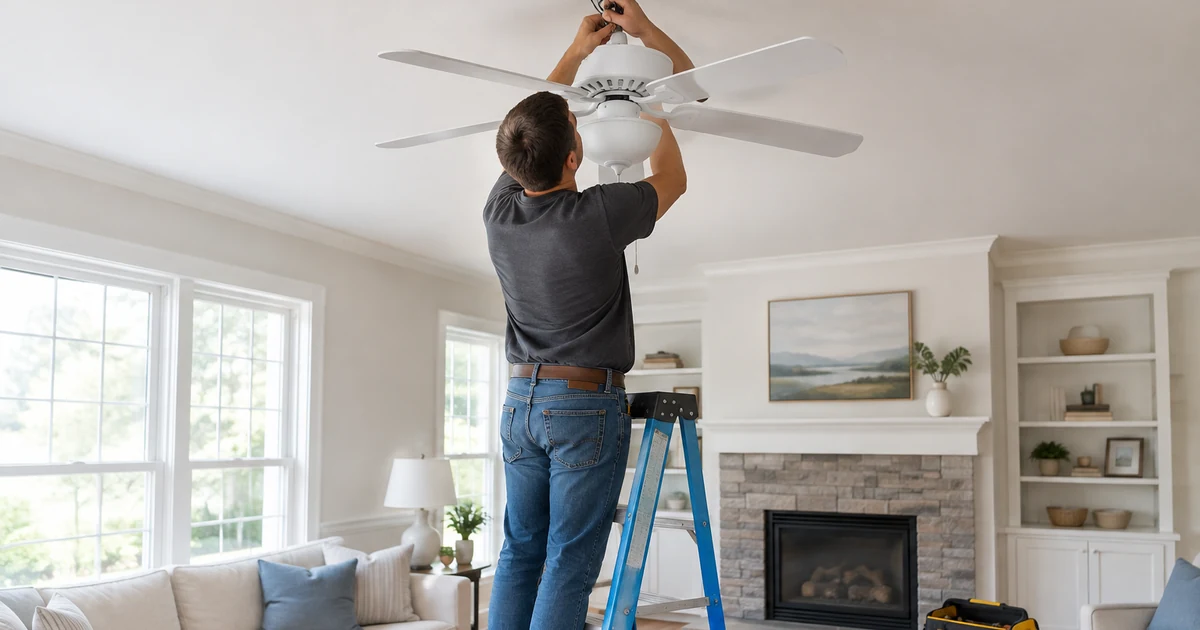
Most of what you pay depends on what’s already in the ceiling. Hanging a fan on an existing fan-rated box takes about an hour. Running new cable to a spot that has never had power can take half a day or more, plus drywall patching.
| Job type | Typical labor cost | Time | What’s involved |
|---|---|---|---|
| Replace an existing ceiling fan | $100–$300 | About 1 hour | Remove old fan, hang and wire the new one |
| Replace a light fixture with a fan | $150–$350 | 1–2 hours | Check or upgrade to a fan-rated box and brace |
| New location, attic access | $400–$800 | 2–3 hours | New box, cable run from attic, new switch |
| New location, finished ceiling | $500–$1,200+ | Half day or more | Fishing wire through walls and ceiling, patch openings |
| New circuit required | Add $150–$600 | Varies | Dedicated run from the electrical panel |
National averages for ceiling fan installation sit around $250 for the labor on a standard job, which matches the most common scenario: swapping a light fixture for a fan. If you’re buying the fan through the installer, add its price on top.
Swapping a light for a fan often costs a little more than a fan-for-fan swap because many light fixture boxes aren’t built to carry a fan’s weight and vibration. Electrical code requires a box listed for fan support, so the installer may need to add a brace between joists.
Cost Breakdown: Materials vs. Labor
Labor is usually the smaller part of the bill once you add a mid-range fan. Electricians typically charge $50 to $130 an hour, and handymen $50 to $80 an hour for simple swaps where wiring already exists. Many pros quote a flat rate per fan instead.
| Item | Typical cost |
|---|---|
| Standard or low-profile fan | $50–$300 |
| ENERGY STAR or fan with light kit | $200–$500 |
| Smart fan | $250–$600 |
| Outdoor (damp- or wet-rated) fan | $200–$600 |
| Dual-motor or designer fan | $200–$1,500 |
| Labor, existing wiring | $150–$350 |
| New wiring | $200–$400+ on top of labor |
| Separate fan and light wall switches | $100–$200 |
| Extended downrod | $10–$75 |
| Remote control kit | $15–$30 |
| Permit, where required | $20–$100 |
Ceiling Fan Cost by Size
Blade span affects both the fan’s price and how well it works in the room. Larger fans cost more, but an undersized fan has to run on high to move enough air.
| Blade span | Fan cost | Good for |
|---|---|---|
| 29–36 inches | $50–$300 | Small bedrooms, offices, laundry rooms |
| 42–52 inches | $100–$500 | Average bedrooms and family rooms |
| 60+ inches | $150–$600 | Large living areas and open floor plans |
The U.S. Department of Energy notes that a 36- or 44-inch fan can cool rooms up to 225 square feet, while fans of 52 inches or more work best in larger spaces. Rooms longer than about 18 feet may do better with two fans. For comfort, DOE recommends blades 7 to 9 feet above the floor and 10 to 12 inches below the ceiling, with at least 8 inches of ceiling clearance and 18 inches from walls.
Running costs are low. Cost guides estimate a few dollars a month for a fan used most of the day, and DOE says ENERGY STAR certified fans are up to 40% more efficient on average than conventional models. Using a fan with air conditioning lets you raise the thermostat about 4°F with no loss of comfort, according to DOE.
Other Factors That Affect the Price
Ceiling height
Standard 8- to 9-foot ceilings are the base price. Vaulted or two-story ceilings need a longer downrod, a taller ladder or scaffolding, and often a second person. At typical hourly rates, the extra hour or two adds roughly $50 to $260.
Sloped ceilings
Angled ceilings need a fan designed for slopes or an angled mounting kit, which adds a small parts cost and a bit of labor.
Wiring and switches
If you want the fan and light controlled separately from the wall, the installer may need to run a new cable between the switch and the ceiling box. A remote or smart control can sometimes avoid that extra wiring.
Attic access
An accessible attic above the ceiling makes new runs much faster. Without one, the electrician cuts access holes, and patching and painting afterward is usually a separate cost. Our drywall repair cost guide covers what those patches typically run.
Panel capacity
A single fan rarely needs its own circuit, but if the room’s circuit is already loaded, or you’re adding several fans and lights, a new circuit may be required. Older homes with full panels may need more work; see electrical panel upgrade cost if yours is out of space.
Outdoor fans
Porches, patios and pergolas need a fan rated for the location: damp-rated for covered areas that stay out of direct rain, wet-rated for spots exposed to weather. Outdoor fans range from under $100 to several thousand dollars, and labor runs higher when the installer has to add a weatherproof box, run cable to the porch ceiling or work around exterior trim.
Smart fans and controls
Smart fans and Wi-Fi wall controls add convenience and, in many cases, let you skip running a new cable for separate fan and light switches. Expect the fan to cost more up front, and allow a little extra labor for pairing the controls and setting up the app. A smart wall switch conversion kit is another option on an existing fan, typically $45 to $60.
Number of fans
Trip charges and setup time are spread across the job, so installing three fans in one visit usually costs less per fan than three separate appointments.
Permits and region
Straight replacements usually don’t need a permit, but new wiring or circuits often do. Where a permit is needed, it typically costs $20 to $100, sometimes with a separate inspection fee. Labor rates vary by market, running higher in large metro areas, and some electricians set a minimum service charge that makes a single quick swap cost about the same as a slightly longer job.
Before you hire: get at least three written, itemized quotes from licensed and insured local pros. Prices for the same job often differ by 30% or more, and comparing line items is the fastest way to spot padding or missing work.
DIY vs. Hiring a Pro
Replacing an existing fan, or swapping a light fixture on a box that’s already fan-rated, is one of the more common DIY electrical jobs. Turn off the breaker, confirm the power is off with a non-contact voltage tester, and follow the fan’s instructions. Plan on two people for lifting the motor, since many fans are awkward to hold overhead while connecting wires.
Hire a licensed electrician when:
- There’s no existing box or wiring at the fan location.
- You’re not sure the box is rated for a fan, or it’s attached only to drywall.
- You need a new switch leg, a new circuit, or work in the panel.
- The ceiling is high or vaulted and safe access is difficult.
- You find aluminum wiring, brittle old insulation or no ground wire.
New wiring usually requires a permit, and an improperly supported fan can loosen over time and fall. For anything beyond a direct swap, the labor cost buys correct support, code-compliant connections and an inspection trail.
How to Save Money on Ceiling Fan Installation
- Install fans where fixtures already exist. Using an existing box avoids the costliest part of the job: new wiring.
- Group several fans into one visit to split the trip charge and setup time.
- Use a remote or smart control instead of running a new cable for separate fan and light switches.
- Get flat-rate quotes from at least two or three electricians or handymen, and compare them with retailer installation services.
- Size the fan to the room. A properly sized fan moves more air at lower speeds, and ENERGY STAR models cost little to run.
- Combine with other electrical work. If you’re already adding outlets, lighting or an attic project such as attic insulation, run the fan wiring while access is open.
Frequently Asked Questions
How much does it cost to have a ceiling fan installed?
Most homeowners pay $150 to $350 in labor, about $250 on average, to install a ceiling fan where a light fixture or fan already exists. Add $50 to $300 for a standard fan. Installing a fan in a new location with new wiring typically totals $400 to $1,000 or more.
How much does an electrician charge to replace a light fixture with a ceiling fan?
Expect about $150 to $350 in labor. The price is usually higher than a fan-for-fan swap because the electrician may need to replace the box with a fan-rated box and brace that can support the fan’s weight and movement.
How much does it cost to install a ceiling fan where there is no light?
Adding a fan where there’s no existing fixture usually costs $400 to $1,000 or more, including a standard fan. The electrician has to install a fan-rated box, run cable and add a switch, and costs rise without attic access or if a new circuit is needed.
Can a handyman install a ceiling fan?
A handyman can often replace an existing fan or swap one onto a fan-rated box where wiring is already in place, depending on local licensing rules. New wiring, new switches and new circuits should be done by a licensed electrician and may need a permit.
How long does it take to install a ceiling fan?
A straight replacement takes about an hour. A light-to-fan swap with a new box takes one to two hours, and a new location with new wiring and switches usually takes two to three hours or more.
Do I need a permit to install a ceiling fan?
Replacing an existing fan or fixture usually doesn’t require one, but new wiring, new switches or a new circuit often does. Permits typically cost $20 to $100, and a licensed electrician normally handles pulling them.