Vinyl Siding Cost by Grade and Thickness
Not all vinyl is the same product. Panel thickness, measured in thousandths of an inch, is the clearest sign of quality: thicker panels lie flatter, resist cracking from hail and lawn debris, and usually carry longer warranties. Prices below are installed, per square foot of wall, without removal of old siding. Siding contractors often quote by the square (100 sq ft), so both are shown.
| Grade | Typical thickness | Installed per sq ft | Installed per square | 1,800 sq ft of wall |
|---|---|---|---|---|
| Builder grade | about 0.040 in. | $3 – $5 | $300 – $500 | $5,400 – $9,000 |
| Standard residential | 0.042 – 0.044 in. | $4 – $7 | $400 – $700 | $7,200 – $12,600 |
| Premium / thick | 0.046 – 0.050 in. | $6 – $10 | $600 – $1,000 | $10,800 – $18,000 |
| Insulated (foam-backed) | varies, with contoured foam | $7 – $12 | $700 – $1,200 | $12,600 – $21,600 |
Builder-grade vinyl is common on new tract homes, but it tends to show waves on long walls and can crack in cold weather when struck. For a re-side you plan to live with for decades, standard residential is the usual minimum, and premium thickness is worth pricing on walls that take a beating from wind, hail, or a busy driveway.
Insulated vinyl has rigid foam fused to the back of each panel. It makes walls straighter, feels more solid when you press on it, and adds a modest amount of insulation over the studs. It costs roughly double the price of basic vinyl, so it makes the most sense in cold climates or on older homes with little wall insulation.
Vinyl Siding Cost by Style
Profile and texture change the price too. Horizontal lap is the cheapest to buy and install; shapes that mimic cedar shakes, stone, or brick use more material per square foot and take longer to hang.
| Vinyl siding style | Installed per sq ft | Where it’s used |
|---|---|---|
| Traditional lap (clapboard) or Dutch lap | $4 – $7 | Whole-house siding; most common choice |
| Log-look | $4 – $8 | Cabins and rustic homes |
| Vertical or board-and-batten | $4 – $9 | Modern farmhouse walls, gables, accents |
| Shake or scalloped | $5 – $10 | Gables, dormers, Cape Cod and cottage homes |
| Stone- or brick-look panels | $5 – $11 | Foundation skirts and entry accents |
Many homes mix styles: lap siding on the main walls with shake or board-and-batten in the gables. That adds visual interest for far less than doing the whole house in a premium profile.
Vinyl Siding Cost by House Size
Vinyl is priced by wall area, not living area. Measure the perimeter, multiply by the wall height, and add the gable triangles. Here are installed prices for standard and insulated vinyl before removal of any old siding:
| Wall area | Squares | Standard vinyl | Insulated vinyl |
|---|---|---|---|
| 1,000 sq ft | 10 | $4,000 – $7,000 | $7,000 – $12,000 |
| 1,500 sq ft | 15 | $6,000 – $10,500 | $10,500 – $18,000 |
| 2,000 sq ft | 20 | $8,000 – $14,000 | $14,000 – $24,000 |
| 2,500 sq ft | 25 | $10,000 – $17,500 | $17,500 – $30,000 |
| 3,000 sq ft | 30 | $12,000 – $21,000 | $21,000 – $36,000 |
Location moves these numbers a lot. Angi’s city-level estimates for vinyl on a 2,000 sq ft home range from around $7,100 in Houston and $11,800 in Chicago to about $16,500 in Boston. Use the region setting in the calculator to adjust for your area.
Cost Breakdown: Materials vs. Labor
Labor typically makes up 30% to 50% of a vinyl siding job, or about $2 to $5 per sq ft. On a $12,000 project, that’s roughly $3,600 to $6,000 for installation. The rest goes to panels and the accessories that make vinyl work: starter strip, J-channel around windows and doors, inside and outside corner posts, utility trim under windows, and corrosion-resistant nails.
These items often appear as separate lines on a quote:
- Removal and disposal of old siding: $0.70 to $2.00 per sq ft, commonly $1,000 to $2,500 for a whole house.
- House wrap: $0.50 to $2.00 per sq ft if the existing barrier is missing or damaged.
- Window trim and flashing: $1,500 to $3,000 for a typical house.
- Vinyl soffit: $1,000 to $4,000; fascia wrap: $1,000 to $3,300.
- Sheathing or framing repairs: $500 to $5,000 depending on what’s found.
- Permit: $50 to $500 in most towns.
Other Factors That Affect Vinyl Siding Cost
Color
White, beige, and light gray are the least expensive. Dark and saturated colors use fade-resistant formulas and usually cost more, and very dark vinyl can warp if reflected sunlight from a neighbor’s low-E windows hits it.
Height and complexity
Two-story walls need staging, and each corner, gable, dormer, and bay window adds trim pieces and cutting time. A simple rectangular ranch is the cheapest house to side per square foot.
Condition of the walls
Vinyl only looks as straight as the wall behind it. Bowed walls, missing sheathing, or rot at the sill need to be fixed first, and some installers add foam backer board to smooth out uneven surfaces.
What’s being removed
Removing old vinyl or wood is routine. Older homes with cement-asbestos shingles need testing, and if asbestos is present, removal must follow state and EPA rules, which raises the cost. Some owners side over those shingles instead, where local code allows.
Season and demand
Vinyl becomes brittle in cold weather, so many crews slow down in winter in northern states. Spring and summer are peak season, and spring storms can fill schedules fast.
Before you hire: get at least three written, itemized quotes from licensed and insured local pros. Prices for the same job often differ by 30% or more, and comparing line items is the fastest way to spot padding or missing work.
Vinyl Siding vs. Other Siding Materials
Vinyl costs less than most alternatives and never needs painting. It typically lasts 30 to 40 years, and new siding recovers a solid share of its cost at resale. The trade-offs: it can crack from impact, melt near a grill, and it doesn’t look quite like painted wood up close.
Fiber cement and engineered wood cost more to install but resist impact and fire better and take paint. Steel stands up to hail. Over the long run, the price gap widens in vinyl’s favor: fiber cement and wood need repainting every several years, a recurring cost vinyl avoids entirely, while vinyl upkeep is mostly an annual rinse with a garden hose and a soft brush. For a side-by-side of every material, see our full siding installation cost guide.
DIY vs. Hiring a Pro
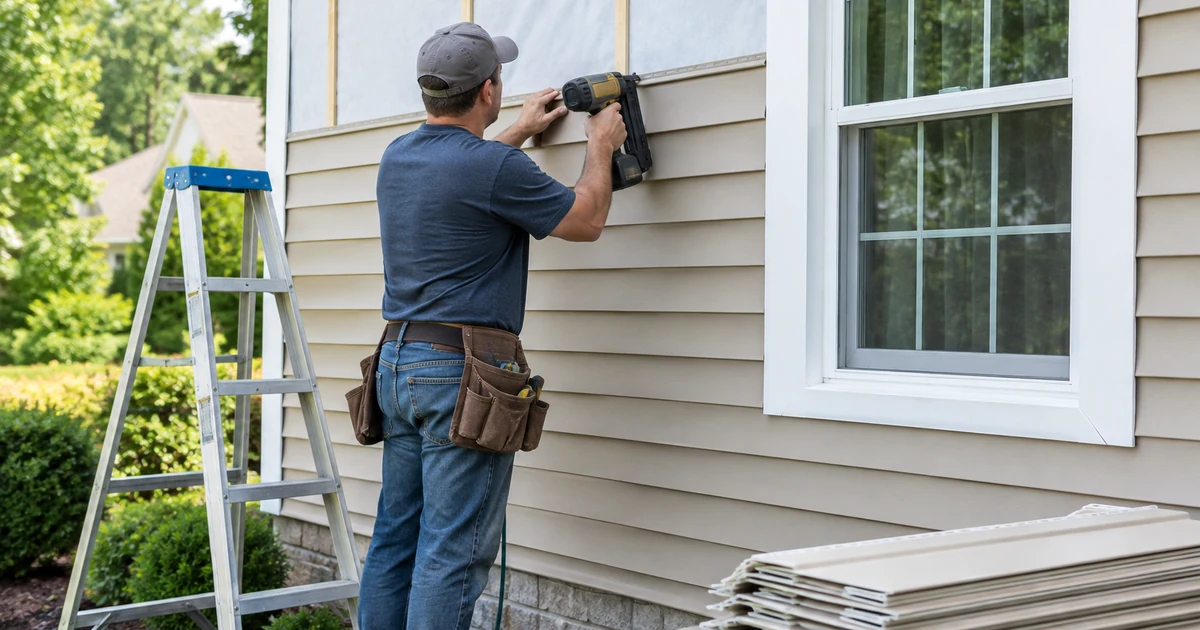
Vinyl is the most DIY-friendly siding, and handy homeowners can save the labor share on a one-story house or a garage. The critical detail is that vinyl moves with temperature: panels must be nailed in the center of the slots, not driven tight, and cut short of the J-channel to leave room for expansion. Get that wrong and panels buckle in the first heat wave.
Hire a pro for two-story walls, for homes needing sheathing repairs, or when you want a manufacturer’s warranty, since many require professional installation. Most towns require a permit for a full re-side.
How to Save Money on Vinyl Siding
- Choose standard residential thickness rather than premium for walls that don’t face storms or heavy wear.
- Use premium profiles only as accents, such as shake in the gables and lap on the main walls.
- Stick with a stock color. Light, widely stocked colors cost less and are easier to match later.
- Get at least three quotes naming the exact product line and thickness, so you’re comparing like for like.
- Bundle with other exterior work like window replacement or new gutters to share trim and setup costs.
- Don’t plan around the federal tax credit. The 25C home efficiency credit ended for work completed after December 31, 2025. Check your utility for any local insulation rebates instead.
- Repair instead of replacing when damage is limited to a few panels; spot repairs usually cost $2 to $4 per sq ft.
Frequently Asked Questions
How much does vinyl siding cost per square?
Installed vinyl siding costs about $300 to $1,200 per square (100 sq ft). Builder grade runs $300 to $500 per square, standard residential $400 to $700, premium thickness $600 to $1,000, and insulated vinyl $700 to $1,200, before removal of old siding.
How much does it cost to put vinyl siding on a 2,000 sq ft house?
A 2,000 sq ft two-story home often has 1,800 to 2,500 sq ft of wall. With standard vinyl and tear-off, expect roughly $8,500 to $22,500, with many projects near $12,000 to $15,000. Insulated vinyl can push the total past $25,000.
Is insulated vinyl siding worth it?
Insulated vinyl costs roughly twice as much as basic vinyl. It gives straighter walls, better impact resistance, and some added insulation, so it pays off best in cold climates or on older homes with little wall insulation. In mild climates, standard or premium thickness is usually the better value.
What thickness of vinyl siding is best?
For a whole-house re-side, 0.042 to 0.044 inch standard residential vinyl is a sensible minimum. Premium panels around 0.046 inch and up resist waviness and impact better and are worth it on exposed or storm-prone walls.
How long does vinyl siding last?
Quality vinyl siding typically lasts 30 to 40 years. Thin builder-grade panels, dark colors in strong sun, and poor installation can shorten that, while good ventilation behind the panels and occasional washing help it last.
Can you paint vinyl siding instead of replacing it?
Yes, if the panels are sound. Painting costs about $1 to $3 per sq ft using vinyl-safe paint in a color no darker than the original, since darker colors can absorb enough heat to warp the panels.