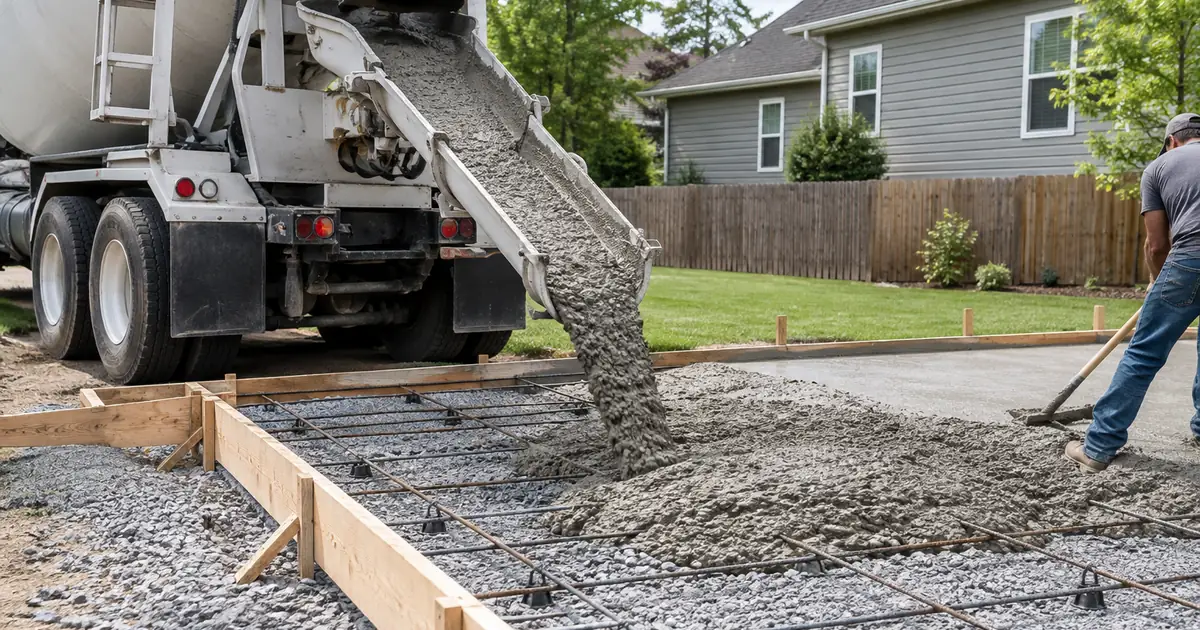
The calculator above estimates what a finished slab costs. To work out how much concrete to order, use the formula and the quick-reference tables below.
How to Calculate Concrete for a Slab
Concrete is ordered by volume. Ready-mix plants sell it by the cubic yard, and bagged mix is labeled by the cubic feet each bag yields. The math is the same for a patio, a shed pad, a driveway, or a garage floor:
- Measure length and width in feet. Split L-shapes into rectangles and add them together.
- Convert thickness to feet by dividing inches by 12. Four inches is 0.333 ft; 6 inches is 0.5 ft.
- Multiply: length × width × thickness = cubic feet.
- Divide by 27 to get cubic yards, since one cubic yard equals 27 cubic feet.
- Add 5% to 10% for waste, uneven subgrade, and spillage. Use the higher figure when the ground is rough or the forms are long and irregular.
Example: a 10 x 12 ft patio at 4 inches thick is 10 × 12 × 0.333 = 40 cubic feet, or 1.48 cubic yards. With 10% extra, order about 1.63 yards; most plants sell in quarter-yard increments, so you would order 1.75 yards. In 80-lb bags, the same slab needs 40 ÷ 0.6 = 67 bags, or about 74 with the extra 10%.
Round forms: for a circular pad or post hole, use π × radius² × depth, with all measurements in feet. A 12-inch-diameter hole 36 inches deep holds 3.1416 × 0.5 × 0.5 × 3 = 2.36 cubic feet, or four 80-lb bags.
Quick Reference: Cubic Yards and 80-lb Bags by Slab Size
Volumes below are exact, with no waste added. Bag counts assume 80-lb bags yielding 0.6 cubic feet each, rounded up. Add 5% to 10% before you order.
| Slab size | Sq ft | 4 in. thick | 5 in. thick | 6 in. thick |
|---|---|---|---|---|
| 4 x 4 ft | 16 | 0.20 yd³ · 9 bags | 0.25 yd³ · 12 bags | 0.30 yd³ · 14 bags |
| 10 x 10 ft | 100 | 1.23 yd³ · 56 bags | 1.54 yd³ · 70 bags | 1.85 yd³ · 84 bags |
| 10 x 12 ft | 120 | 1.48 yd³ · 67 bags | 1.85 yd³ · 84 bags | 2.22 yd³ · 100 bags |
| 12 x 12 ft | 144 | 1.78 yd³ · 80 bags | 2.22 yd³ · 100 bags | 2.67 yd³ · 120 bags |
| 10 x 20 ft | 200 | 2.47 yd³ · 112 bags | 3.09 yd³ · 139 bags | 3.70 yd³ · 167 bags |
| 12 x 20 ft | 240 | 2.96 yd³ · 134 bags | 3.70 yd³ · 167 bags | 4.44 yd³ · 200 bags |
| 16 x 18 ft | 288 | 3.56 yd³ · 160 bags | 4.44 yd³ · 200 bags | 5.33 yd³ · 240 bags |
| 20 x 20 ft | 400 | 4.94 yd³ · 223 bags | 6.17 yd³ · 278 bags | 7.41 yd³ · 334 bags |
| 24 x 24 ft | 576 | 7.11 yd³ · 320 bags | 8.89 yd³ · 400 bags | 10.67 yd³ · 480 bags |
| 24 x 36 ft | 864 | 10.67 yd³ · 480 bags | 13.33 yd³ · 600 bags | 16.00 yd³ · 720 bags |
A useful shortcut: at 4 inches thick, one cubic yard covers 81 square feet. At 5 inches it covers about 65 square feet, and at 6 inches, 54 square feet.
How Many Bags of Concrete per Cubic Yard?
Bag yields come from the manufacturer’s data sheet. Standard concrete mix from major brands yields about 0.30 cubic feet per 40-lb bag, 0.45 per 60-lb bag, and 0.60 per 80-lb bag.
| Bag size | Yield per bag | Bags per cubic yard | Bags per 10 sq ft at 4 in. |
|---|---|---|---|
| 40 lb | 0.30 cu ft | 90 | 11.1 |
| 50 lb | 0.375 cu ft | 72 | 8.9 |
| 60 lb | 0.45 cu ft | 60 | 7.4 |
| 80 lb | 0.60 cu ft | 45 | 5.6 |
A full cubic yard of bagged concrete weighs about 3,600 pounds in 80-lb bags. That weight matters when you plan how many trips your truck can make and how much your crew can mix in a day.
Ready-Mix vs. Bags: Cost per Cubic Yard
Ready-mix concrete delivered by truck generally costs $120 to $195 per cubic yard, depending on region and mix strength. Plants typically add a short-load fee of about $40 to $60 per yard when you order less than a full truck, which is roughly 10 yards. Bagged concrete costs more per yard but has no delivery minimum.
| Option | Cost per cubic yard | Best for |
|---|---|---|
| 80-lb bags, 45 per yard at about $5 – $8 each | $225 – $360 | Under 1 yard: post holes, pads, steps, repairs |
| Ready-mix, short load (under ~10 yards) | $160 – $255 | 1 to 10 yards: patios, walkways, shed pads |
| Ready-mix, full truck | $120 – $195 | Driveways, garage floors, large slabs |
The practical crossover is around one cubic yard. Below that, bags are simpler and cheaper once delivery minimums are counted. Above two yards, ready-mix wins easily: mixing 90 or more bags by hand is slow, and a slab poured in batches can show cold joints where fresh concrete meets concrete that has already begun to set.
Concrete Slab Cost: Materials vs. Labor
A professionally installed plain concrete slab typically runs $6 to $12 per square foot, which is what the calculator uses by default. Labor usually makes up 40% to 50% of that price. Here is how a 4-inch slab breaks down:
| Item | Cost per sq ft | 20 x 20 ft slab (400 sq ft) |
|---|---|---|
| Concrete (about 5 yards at $120 – $195 plus any short-load fee) | $1.50 – $3.00 | $600 – $1,200 |
| Gravel base, forms, reinforcement, joints | $1.50 – $4.00 | $600 – $1,600 |
| Labor: excavation, forming, placing, finishing | $3.00 – $5.00 | $1,200 – $2,000 |
| Total installed | $6.00 – $12.00 | $2,400 – $4,800 |
Thicker slabs cost more, but not in direct proportion to the concrete, because labor and forming change little between 4 and 6 inches:
| Thickness | Typical use | Installed cost per sq ft |
|---|---|---|
| 4 in. | Patios, walkways, sheds, car driveways | $6 – $12 |
| 5 in. | Garage floors, heavier pickups | $6.90 – $13.80 |
| 6 in. | RV pads, hot tubs, heavy trucks | $7.80 – $15.60 |
| 8 in. | Heavy equipment, shop floors | $9.60 – $19.20 |
Decorative work raises the price further. Stamped or colored slabs commonly run $10 to $18 per square foot or more. For project-specific numbers, see our guides to concrete patio cost and concrete driveway cost.
Other Factors That Affect Concrete Cost
Waste and over-ordering
Running short mid-pour is far worse than having a little left over. Subgrade is never perfectly flat, and a half-inch low spot across a 400 sq ft slab uses about 0.6 extra cubic yards. That is why a 5% to 10% allowance is standard.
Site prep and base
Most slabs sit on 4 inches of compacted gravel. If a quote doesn’t include it, expect roughly $1 to $3 more per square foot. Sloped or soft ground needs extra fill and compaction.
Removing old concrete
Breaking out and hauling an existing slab costs about $3 to $8 per square foot including disposal, with reinforced concrete at the higher end.
Reinforcement
Fiber mesh in the mix, welded wire mesh, or a rebar grid each add cost. Rebar makes the most sense for thicker slabs, heavy loads, and expansive clay soils.
Access and pumping
If the ready-mix truck can’t back up to the forms, the concrete has to be pumped or moved by wheelbarrow, which adds equipment or labor cost.
Location and season
Concrete and labor prices vary by region. Hot weather speeds setting and cold weather may require heated water, accelerators, or insulated blankets, all of which can add to the bill.
Before you hire: get at least three written, itemized quotes from licensed and insured local pros. Prices for the same job often differ by 30% or more, and comparing line items is the fastest way to spot padding or missing work.
DIY vs. Hiring a Pro
Small pours are a good DIY project. Setting fence posts, pouring a 4 x 4 ft pad for an AC unit, or forming a few steps takes only a handful of bags and basic tools. A 10 x 10 slab at 4 inches, about 56 bags of 80-lb mix, is realistic with a rented mixer and two helpers.
Past about 150 square feet, the job changes. You’ll be ordering ready-mix, and once the truck arrives the concrete has to be placed, screeded, floated, edged, jointed, and finished before it stiffens. Driveways and garage floors usually need a crew of three or more experienced finishers. Always call 811 before digging, and check whether your town requires a permit for new slabs.
How to Save Money on Concrete
- Measure twice and order once. An accurate volume with 5% to 10% extra avoids both a second short-load fee and paying for concrete you’ll throw away.
- Combine pours. A patio, walkway, and shed pad poured on the same day can fill a truck and avoid short-load fees.
- Use bags only for small jobs. Above a yard or so, ready-mix is cheaper and produces a more consistent slab.
- Prepare the site yourself. Excavating, building the base, and setting forms before the crew arrives can lower the labor bill.
- Keep the finish simple. A broom finish costs a fraction of stamping and performs just as well.
- Plan truck access. Clearing a path for the truck can save the cost of a pump.
- Compare at least three quotes that specify thickness, PSI, base depth, and reinforcement.
Frequently Asked Questions
How many 80-lb bags of concrete make a yard?
About 45. An 80-lb bag of standard concrete mix yields roughly 0.6 cubic feet, and a cubic yard is 27 cubic feet. You’d need 60 bags of 60-lb mix or 90 bags of 40-lb mix for the same volume.
How much concrete do I need for a 10×10 slab?
At 4 inches thick, a 10 x 10 ft slab needs 1.23 cubic yards (33.3 cubic feet), or about 56 bags of 80-lb mix. Add 5% to 10% for waste, which brings it to roughly 1.3 to 1.35 yards or 59 to 62 bags.
How much does a yard of concrete cost?
Ready-mix typically costs $120 to $195 per cubic yard delivered, plus a short-load fee of about $40 to $60 per yard on orders smaller than a full truck. Bagged concrete works out to roughly $225 to $360 per yard.
How many square feet does a yard of concrete cover?
One cubic yard covers 81 square feet at 4 inches thick, about 65 square feet at 5 inches, and 54 square feet at 6 inches.
Is it cheaper to mix concrete yourself or buy ready-mix?
For less than about one cubic yard, bags are usually cheaper and easier. Beyond two yards, ready-mix costs less per yard, saves hours of mixing, and gives a more uniform slab without cold joints.
How thick should a concrete slab be?
Four inches is standard for patios, walkways, sheds, and car driveways. Use 5 to 6 inches for garage floors, RV pads, hot tubs, or driveways that see heavy trucks.
How much does it cost to pour a 20×20 concrete slab?
A 20 x 20 ft slab is 400 square feet. At $6 to $12 per square foot installed, it typically costs $2,400 to $4,800, with about $3,500 being common for a 4-inch broom-finished slab.