Concrete Patio Cost by Finish
Once size is set, the finish decides the price. A broom-finished slab is the budget baseline; coloring, exposed aggregate, and stamping each add labor and materials. Figures are installed prices for a 4-inch patio on a normal backyard site.
| Finish | Cost per sq ft | 300 sq ft patio | Upkeep |
|---|---|---|---|
| Broom or plain finish | $7 – $13 | $2,100 – $3,900 | Optional sealing |
| Integral color or acid stain | $9 – $17 | $2,700 – $5,100 | Reseal every few years |
| Exposed aggregate | $9.50 – $17.50 | $2,840 – $5,270 | Reseal every few years |
| Stamped, one pattern and color | $11 – $21 | $3,360 – $6,240 | Reseal every 2–3 years |
| Stamped multi-color with borders | $14 – $26 | $4,200 – $7,800 | Reseal every 2–3 years |
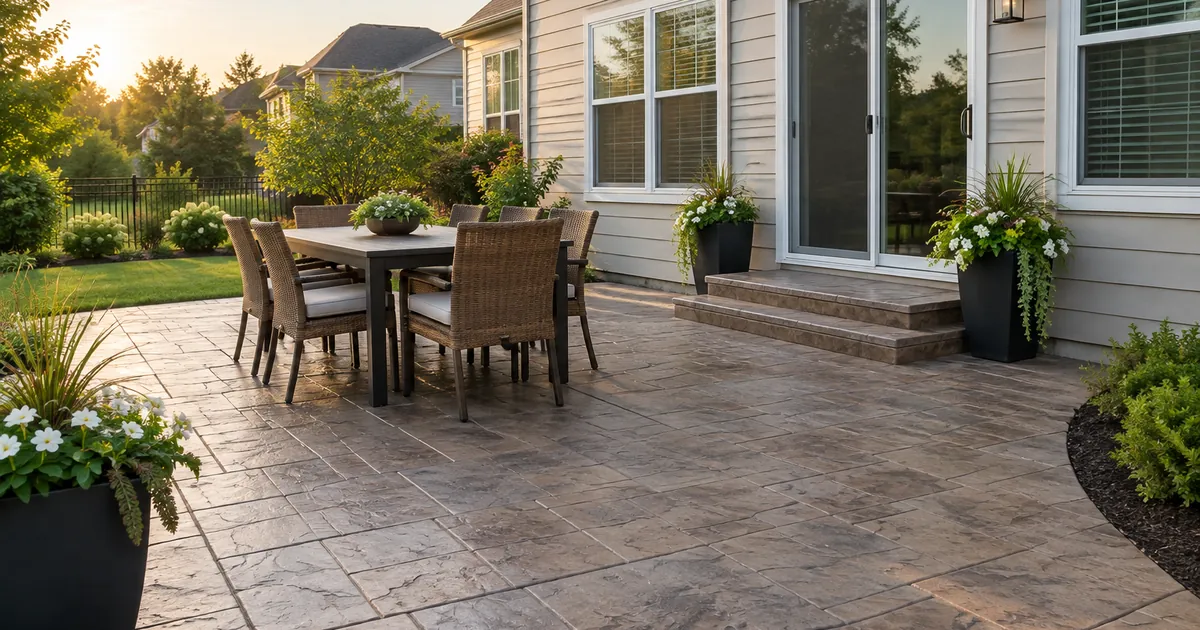
Stamped concrete is the most popular upgrade because it can imitate flagstone, slate, brick, or wood plank for less than the natural material. Two cautions: the texture can be slick when wet unless the sealer includes an anti-slip additive, and the color fades without resealing. Exposed aggregate hides dirt well and gives good grip, which makes it a practical choice around pools.
You can also split the difference. A broom-finished field with a stamped or colored border often looks custom at a fraction of the cost of stamping the entire slab.
Concrete Patio Cost by Size
These estimates use $7 to $13 per square foot for broom finish and $11 to $21 for basic stamped work. The typical column matches the calculator’s default of about $9.70 per square foot.
| Patio size | Broom finish | Typical broom | Stamped |
|---|---|---|---|
| 10 x 10 ft (100 sq ft) | $700 – $1,300 | $970 | $1,120 – $2,080 |
| 12 x 12 ft (144 sq ft) | $1,000 – $1,900 | $1,400 | $1,610 – $3,000 |
| 12 x 16 ft (192 sq ft) | $1,340 – $2,500 | $1,860 | $2,150 – $3,990 |
| 16 x 18 ft (288 sq ft) | $2,000 – $3,700 | $2,790 | $3,230 – $5,990 |
| 15 x 20 ft (300 sq ft) | $2,100 – $3,900 | $2,910 | $3,360 – $6,240 |
| 20 x 20 ft (400 sq ft) | $2,800 – $5,200 | $3,880 | $4,480 – $8,320 |
| 20 x 24 ft (480 sq ft) | $3,360 – $6,240 | $4,660 | $5,380 – $9,980 |
Small patios often cost more per square foot than the table shows, because many contractors have a minimum charge that covers crew time, forming, and the concrete delivery. If your quote for a 10 x 10 slab comes back near $1,500, that is usually why.
Cost Breakdown: Materials vs. Labor
Here is how a standard broom-finished patio breaks down per square foot:
| Item | Cost per sq ft | 300 sq ft patio |
|---|---|---|
| Ready-mix concrete, 4 in. thick ($130 – $180 per cubic yard) | $1.60 – $2.40 | $480 – $720 |
| Compacted gravel base | $0.50 – $1.50 | $150 – $450 |
| Wire mesh, fiber, or rebar | $0.50 – $1.50 | $150 – $450 |
| Labor: excavation, forming, pouring, finishing, control joints | $4.00 – $7.50 | $1,200 – $2,250 |
| Total | $6.60 – $12.90 | $1,980 – $3,870 |
A 300 sq ft patio at 4 inches takes about 3.7 cubic yards of concrete, or roughly 4 yards with waste. Use our concrete calculator to check volumes for other sizes and thicknesses.
Other Factors That Affect the Price
Site prep and grading
A flat, well-drained yard needs only shallow excavation and a gravel base. Sloped yards may need fill, compaction, or a small retaining edge, and leveling work of that kind commonly adds $1,000 to $3,200. The patio should slope slightly away from the house, about 1/8 to 1/4 inch per foot, so rain doesn’t run toward the foundation.
Removing an old patio
Breaking out and hauling an existing slab usually costs $550 to $1,700 for a typical patio, or roughly $3 to $8 per square foot including disposal. Reinforced slabs cost more to remove.
Access to the backyard
Most patios are behind the house, where a concrete truck can’t reach. Crews then pump the concrete over the house or through a side yard, or wheel it in, and either option adds cost. A gate at least 8 feet wide or a clear driveway path can make a real difference to the quote.
Thickness and special loads
Four inches is standard for foot traffic and furniture. A slab that will carry a hot tub, an outdoor kitchen, or pergola posts may need 6 inches, thickened edges, or separate footings. Tell every bidder about planned heavy items up front.
Shape and design
Rectangles are fastest to form. Curves, multiple levels, built-in steps, and seat walls take more forming and finishing time.
Permits
Some towns require a permit for a new patio slab, especially one attached to the house or covered by a roof, typically $50 to $400. Check setback and lot-coverage rules as well.
Add-ons
Popular extras include a built-in fire pit ($325 to $2,000), steps down to the lawn, lighting conduit cast into the slab, and a roof or pergola, which can cost far more than the patio itself.
Before you hire: get at least three written, itemized quotes from licensed and insured local pros. Prices for the same job often differ by 30% or more, and comparing line items is the fastest way to spot padding or missing work.
DIY vs. Hiring a Pro
A small, simple slab is within reach for a handy homeowner. A 10 x 10 ft patio at 4 inches needs about 1.2 cubic yards of concrete, or roughly 56 bags of 80-lb mix before waste. That is a lot of mixing, but it is doable with a rented mixer and two or three helpers.
Beyond about 150 square feet, ready-mix delivery and a finishing crew make more sense. Concrete sets on its own schedule, and a large slab needs to be screeded, floated, edged, jointed, and textured before it stiffens. Mistakes in slope or joint spacing are permanent. Stamped and colored concrete should be left to experienced decorative installers; timing the stamps is a skill that takes years to learn.
Call 811 before digging, and keep furniture off new concrete for at least a few days. Full strength develops over about 28 days.
Replace or Resurface an Old Patio?
If your existing slab is structurally sound but stained, scaled, or simply dated, a resurfacing overlay costs about $3 to $10 per square foot, well below a new pour plus removal. Overlays can be stamped, stained, or textured, so a plain gray slab can get a decorative finish without being torn out.
Resurfacing is the wrong fix when the slab has sunk, heaved, or cracked through in several places, or when water pools against the house. Those problems start in the base, and an overlay will crack along the same lines. In that case, remove the old patio and start over with proper grading.
Concrete vs. Pavers or a Deck
A poured concrete patio is usually the lowest-cost hard surface per square foot. Pavers cost more to install but let you replace individual units and flex better with frost. A wood or composite deck makes more sense on a sloped lot or when the door sits well above grade. Compare prices in our paver patio cost and deck cost guides.
How to Save Money on a Concrete Patio
- Choose a broom finish and add a stamped or colored border instead of decorating the whole slab.
- Keep the shape simple. A rectangle with square corners is the fastest to form and finish.
- Pour with other flatwork. Adding a walkway or a driveway repair to the same pour spreads setup costs and can avoid short-load fees on small concrete orders.
- Do the demolition or clearing yourself if you can haul the debris.
- Give the truck access. Removing a fence panel for a day can save the cost of a pump.
- Get three quotes that list thickness, reinforcement, base depth, and finish so they can be compared directly.
- Seal it yourself. Rolling on sealer every few years is an easy DIY job that protects color and resists stains.
Frequently Asked Questions
How much does a 12×12 concrete patio cost?
A 12 x 12 ft patio is 144 square feet, so it typically costs $1,000 to $1,900 with a broom finish, or about $1,600 to $3,000 stamped. Contractor minimum charges can push small patios toward the top of the range.
Is stamped concrete worth the cost?
It can be if you want the look of stone or brick for less than natural pavers. Expect to pay 50% to 100% more than a plain slab and to reseal every two to three years to keep the color and surface protection.
Is a concrete patio cheaper than pavers?
Usually, yes. A broom-finished concrete patio is one of the lowest-cost hard surfaces. Pavers cost more up front but are easier to repair one section at a time and handle frost movement well.
How thick should a concrete patio be?
Four inches over a compacted gravel base is standard. Plan on 6 inches or thickened sections under hot tubs, outdoor kitchens, or posts that support a roof or pergola.
Do I need a permit for a concrete patio?
It depends on your town. Ground-level patios often don’t need one, but patios attached to the house, covered by a roof, or near property lines may. Permit fees usually run $50 to $400.
How long does a concrete patio last?
A well-built concrete patio can last for decades. A good base, proper slope away from the house, and correctly spaced control joints matter more than the finish.