AC Compressor Replacement Cost by System Size
The compressor is sized to match the rest of the system, so tonnage is the first thing that moves the price. A larger compressor costs more to buy, holds more refrigerant and is heavier to handle. Prices below assume an out-of-warranty, single-stage replacement in a central split system, including labor and refrigerant.
| System size | Home size (approx.) | Typical replacement cost |
|---|---|---|
| 1.5 – 2 tons | 600 – 1,200 sq ft | $1,100 – $2,100 |
| 2.5 – 3 tons | 1,200 – 1,900 sq ft | $1,300 – $2,500 |
| 3.5 – 4 tons | 1,900 – 2,600 sq ft | $1,500 – $2,800 |
| 5 tons | 2,600+ sq ft | $1,800 – $3,500 |
National cost guides disagree more than usual on this repair. Some put the typical bill near $1,200 to $1,550, while others report averages above $2,300. The gap comes down to what’s included: a bare compressor swap on a small unit at one end, and a larger system with a new filter drier, electrical parts and a full refrigerant charge at the other. For most 3-ton systems, about $1,850 is a realistic midpoint.
Cost by compressor type
The type of compressor also matters. Most residential central air units use a single-stage scroll compressor. Two-stage and variable-speed (inverter) compressors cost more because the parts are pricier and harder to source, and the work often needs a technician familiar with that brand’s controls. Expect roughly 20 percent more for a two-stage replacement and 40 to 50 percent more for a variable-speed unit. Ductless mini-splits use rotary inverter compressors, and replacements there commonly run $600 to $1,000 or more.
Cost Breakdown: Parts vs. Labor
A compressor swap is one of the most labor-intensive repairs an HVAC technician does. The system has to be emptied of refrigerant, the old compressor cut out and the new one brazed in, then the system is pressure-tested, evacuated with a vacuum pump and recharged.
| Item | Typical cost |
|---|---|
| Compressor (part only) | $500 – $1,500 |
| Labor (4 – 8 hours) | $400 – $900 |
| Refrigerant recovery and recharge | $150 – $600 |
| Filter drier, capacitor, contactor | $100 – $300 |
| Service call / diagnosis | $75 – $200 |
Labor usually runs $75 to $150 per hour, though many contractors quote a flat price for the whole job. Replacing the capacitor and contactor at the same time is inexpensive insurance, since a weak capacitor is a common reason compressors fail in the first place.
Other Factors That Affect the Price
Warranty coverage
This is the biggest variable. Most manufacturers warranty the compressor for 5 to 10 years, and some premium lines offer 12 years or a limited lifetime warranty when the unit is registered. If the compressor is covered, you typically pay only labor and refrigerant, roughly $600 to $1,200. Out of warranty, the full bill is usually $1,200 to $2,800.
Refrigerant type
An R-22 system is the worst case. R-22 hasn’t been produced or imported since 2020, so recharging relies on expensive reclaimed supply, and some quotes for R-22 compressor jobs exceed $5,000. Replacing a compressor in an R-22 unit rarely makes sense. R-410A systems can still be repaired, but the refrigerant is being phased down and its price has been rising.
Burnout contamination
When a compressor fails electrically, it can burn its motor windings and leave acid and debris in the lines. The technician may need to flush the system, add a suction-line filter drier and do extra evacuation, which can add a few hundred dollars.
Access
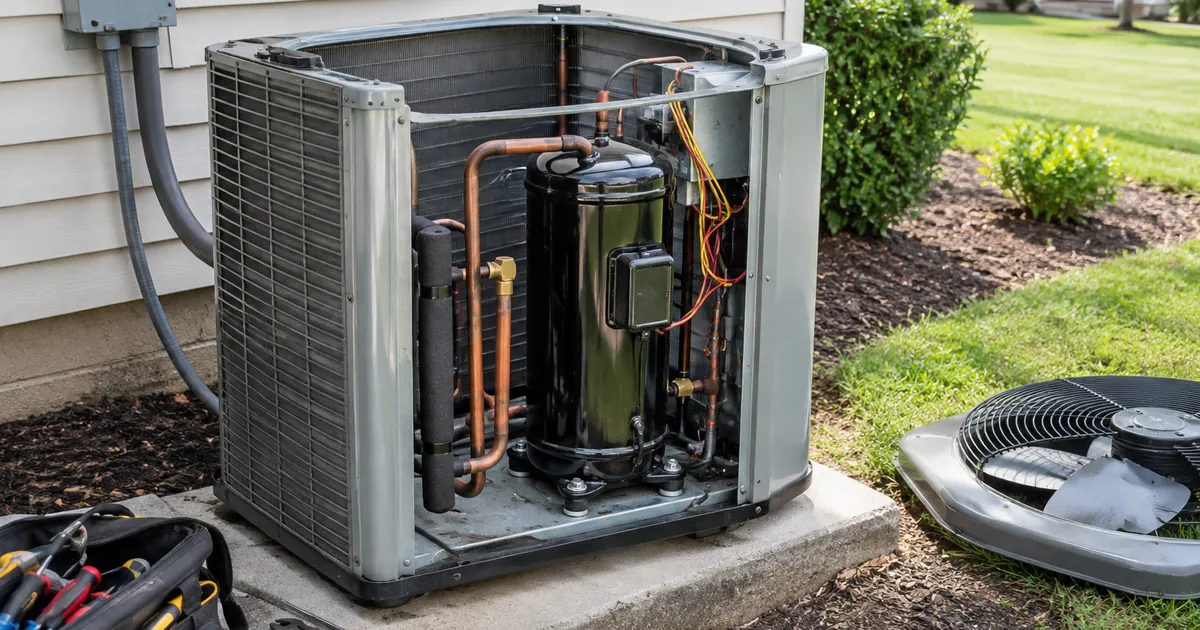
Most compressors sit inside the outdoor condenser, so access is usually straightforward. Rooftop units, tight side yards and condensers boxed in by fences or decks add labor time.
Location and season
Hourly rates vary widely by metro area, and peak cooling season adds wait times and sometimes higher pricing. Emergency and weekend calls can cost 1.5 to 2 times the standard rate.
Before you hire: get at least three written, itemized quotes from licensed and insured local pros. Prices for the same job often differ by 30% or more, and comparing line items is the fastest way to spot padding or missing work.
Signs Your AC Compressor Is Failing
Compressors rarely die without warning. Watch for these symptoms, and call for a diagnosis before a small electrical problem turns into a full compressor failure:
- Warm air from the vents while the outdoor fan is running.
- Loud clanking, grinding or rattling from the outdoor unit when it starts or runs.
- A tripping breaker each time the system tries to start.
- A humming unit that won’t start, which often points to a capacitor but can mean a seized compressor.
- Hard starting or short cycling, where the system turns on and off every few minutes.
Several of these symptoms share cheaper causes, so a proper diagnosis matters. Our AC repair cost guide lists what the most common fixes cost.
Repair vs. Replace the Whole AC Unit
This is the real decision behind a failed compressor. A typical central AC replacement costs about $5,000 to $10,500, so a $1,850 compressor job on the wrong unit can be money poorly spent.
| Situation | Usually the better choice |
|---|---|
| Unit under 8 years old, compressor under warranty | Replace the compressor |
| Unit under 10 years old, out of warranty, otherwise in good shape | Get quotes for both; compressor often wins |
| Unit 10 – 12+ years old | Replace the system |
| System uses R-22 | Replace the system |
| History of refrigerant leaks or other major repairs | Replace the system |
A widely used guideline is the 50 percent rule: if the repair costs half or more of a new system, replacement usually makes more financial sense. Another is to multiply the unit’s age by the repair cost; above $5,000, lean toward replacing. A $2,000 compressor on a 9-year-old unit gives $18,000, a strong signal to price a new system.
There’s also a compatibility question. New central AC systems installed in 2026 generally use A2L refrigerants such as R-454B or R-32, which can’t be mixed into an R-410A system. If you replace only the outdoor unit later, you’ll usually need a matching indoor coil too. Compare the numbers with our AC replacement cost guide, and if your furnace is also aging, a heat pump can handle both heating and cooling.
DIY vs. Hiring a Pro
Compressor replacement is not a DIY project. Federal EPA rules require Section 608 certification to recover and handle refrigerant, and the job needs a recovery machine, brazing torch with nitrogen purge, vacuum pump and micron gauge. The outdoor unit also runs on 240 volts, and the capacitor can store a dangerous charge. Doing the work yourself will void any remaining warranty. What you can safely do is keep the condenser coil clean, change filters on schedule and make sure nothing blocks airflow around the outdoor unit. Keeping shrubs, fencing and stored items at least two feet from the condenser helps the compressor run cooler and can add years to its life.
How to Save Money on a Compressor Replacement
- Find your warranty paperwork. Look up the model and serial number on the manufacturer’s site; a registered unit may have 10 or more years of compressor coverage.
- Get the failure confirmed. Ask for the test readings that show the compressor is shorted, grounded or locked, not just “it’s the compressor.”
- Collect two or three quotes. Prices for this job vary widely, and flat-rate quotes can differ by $1,000 or more.
- Ask about a hard start kit only when it fits. A $150 to $400 hard start kit can help an older compressor that struggles to start, but it won’t revive one that has failed.
- Price a full replacement at the same visit. Utility rebates for high-efficiency systems can narrow the gap. Note that the federal 25C tax credit ended for equipment placed in service after December 31, 2025, so it no longer applies to 2026 installations.
- Book outside peak season when you can. A spring or fall appointment usually avoids emergency rates and long waits.
Frequently Asked Questions
Is it worth replacing the compressor on an AC unit?
It is usually worth it when the unit is under about 10 years old, uses R-410A and the compressor is under warranty. If the system is older, uses R-22, or the repair would cost half or more of a new unit, replacing the whole system is usually the better value.
How long does it take to replace an AC compressor?
Most compressor replacements take 4 to 8 hours of labor. Add time for ordering the part, which can take a few days for less common or variable-speed compressors.
Does the warranty cover AC compressor replacement?
Many manufacturers cover the compressor for 5 to 10 years, and some offer 12 years or longer on registered units. The warranty usually covers the part only, so you still pay labor, refrigerant and the service call, typically $600 to $1,200.
What are the signs of a failing AC compressor?
Common signs include the outdoor unit running while the house stays warm, loud clanking or grinding, the breaker tripping when the unit starts, and a humming unit that won’t start. Some of these also point to a bad capacitor, so get a proper diagnosis first.
Can a bad capacitor ruin a compressor?
Yes. A weak or failed capacitor makes the compressor struggle to start and run, which overheats the motor over time. Replacing a failing capacitor early is far cheaper than replacing the compressor.
How long do AC compressors last?
A well-maintained compressor often lasts 10 to 15 years, roughly the life of the outdoor unit. Dirty coils, low refrigerant and electrical problems shorten that lifespan.