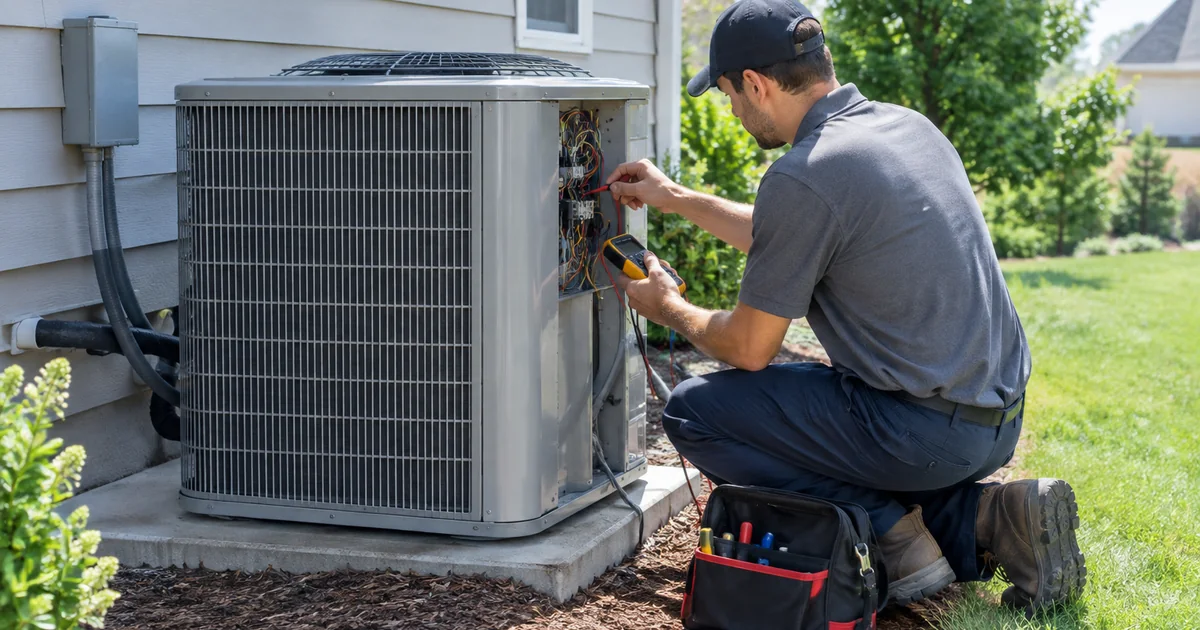
AC Repair Cost by Problem and Part
What broke matters far more than the brand or age of your system. Most service calls end with a small electrical part or a clogged drain, and those bills stay under $500. Refrigerant work, motors and coils are where repair costs climb into four figures.
| Problem / part | Typical repair cost | Common symptom |
|---|---|---|
| Clogged condensate drain line | $75 – $250 | Water around the indoor unit, float switch shuts system off |
| Capacitor | $150 – $450 | Outdoor fan or compressor hums but won’t start |
| Contactor or relay | $150 – $450 | Outdoor unit won’t turn on, or won’t turn off |
| Thermostat replacement | $140 – $350 | System doesn’t respond or short-cycles |
| Circuit / control board | $150 – $700 | Erratic operation, error codes, no power to components |
| Condenser fan motor | $300 – $700 | Outdoor fan not spinning, unit overheats |
| Indoor blower motor | $300 – $900 | Weak or no airflow from vents |
| Refrigerant recharge (no leak repair) | $150 – $600 | Warm air, ice on the refrigerant lines |
| Refrigerant leak find and repair | $200 – $1,500 | Needs recharging every season |
| Evaporator coil replacement | $1,000 – $3,500 | Leak in the indoor coil, frozen coil |
| Compressor replacement | $1,200 – $2,800 | Outdoor unit runs but never cools, breaker trips |
The first four rows cover a large share of summer service calls. A failed capacitor or contactor is a quick swap for a technician because the parts cost well under $100; you’re paying mostly for the trip and the diagnosis. If your outdoor unit hums without starting, read our guide to AC capacitor replacement cost before you approve a bigger repair.
At the other end, coils and compressors are sealed-system repairs. The technician has to recover the refrigerant, braze in the new part, pull a vacuum and recharge the system, which takes most of a day. That labor is why a compressor job lands in the same price conversation as a new unit, covered in detail in our AC compressor replacement cost guide.
Cost Breakdown: Parts vs. Labor
For small repairs, labor and the service call are most of the bill. For sealed-system work, the part and refrigerant take a bigger share, but labor still runs several hundred dollars.
- Service call or diagnostic fee: $75 to $200. Many companies credit it toward the repair if you go ahead with the work.
- Labor: about $75 to $150 per hour during normal business hours, usually with a one-hour minimum.
- After-hours labor: roughly $150 to $300 per hour for nights, weekends and holidays, often double the weekday rate.
- Refrigerant: R-410A is commonly billed at about $50 to $100 per pound installed, and prices have been rising as production is phased down. Older R-22 is far more expensive, often $90 to $150 or more per pound.
- Small electrical parts: capacitors, contactors, relays and fuses cost the contractor little, but expect a markup that brings the part line to $50 to $200.
- Major components: a replacement compressor or evaporator coil can run $500 to $2,000 for the part alone, before labor and refrigerant.
Other Factors That Affect AC Repair Prices
Timing and urgency
A breakdown on a 100-degree Saturday costs more than the same repair on a Tuesday in April. Emergency and weekend rates often run 1.5 to 2 times the standard rate, and some companies add a flat after-hours fee on top.
Type of system
Central split systems cover the widest cost range because they include both an outdoor condenser and an indoor coil. Ductless mini-splits need brand-specific parts and boards, so repairs often run $300 to $1,000. Window and portable units are usually cheaper to replace than to fix once anything beyond a cleaning is needed.
Refrigerant type
Systems that use R-22 have not been able to use newly produced refrigerant since 2020, so any recharge relies on reclaimed stock at a steep price. R-410A systems are still widely serviced, but the refrigerant is being phased down and has become more expensive. Newer systems installed in 2025 and 2026 generally use A2L refrigerants such as R-454B or R-32.
Access and location
An air handler in a cramped attic or crawl space adds labor time, and a condenser on a roof may require extra equipment. Tight access can add an hour or more to a motor or coil job.
Warranty coverage
Many manufacturers cover parts for 5 to 10 years if the unit was registered. When a covered part fails, you usually still pay labor and refrigerant, but the bill can drop by hundreds of dollars. Have your model and serial number ready when you call.
Age and parts availability
Common parts like capacitors and contactors are universal and cheap. Brand-specific control boards, variable-speed blower motors and inverter compressors are not, and parts for discontinued models can take days to arrive or cost noticeably more. Owners of high-efficiency variable-speed systems should expect repair bills toward the top of each range.
Where you live
Labor rates in high-cost metros can run 20 to 40 percent above rural areas. Demand also matters: in hot Southern and Southwestern markets, peak-season wait times and pricing both go up in July and August.
Before you hire: get at least three written, itemized quotes from licensed and insured local pros. Prices for the same job often differ by 30% or more, and comparing line items is the fastest way to spot padding or missing work.
Repair or Replace Your AC?
A repair almost always makes sense when the unit is under about 10 years old and the fix is a small electrical part, a drain line or a thermostat. The harder call comes with refrigerant leaks, coils and compressors on older equipment.
Two common rules of thumb help:
- The 50 percent rule: if the repair costs half or more of what a new system would cost, replacement usually wins.
- The $5,000 rule: multiply the unit’s age by the repair cost. If the result tops $5,000, lean toward replacing. A $900 repair on an 8-year-old unit comes to $7,200, a sign to at least price a new system.
Other signs it’s time to move on: the system uses R-22, it needs refrigerant every summer, it’s 12 to 15 years old, or your cooling bills keep climbing. Compare repair quotes with our AC replacement cost guide before you commit to a major fix. If you also heat with an aging furnace or an electric air handler, a heat pump can replace both at once.
DIY vs. Hiring an HVAC Pro
Some checks are safe and free. Before you book a call, replace a dirty air filter, confirm the thermostat is set to cool with fresh batteries, reset a tripped breaker once, and look for a clogged condensate line or a float switch that has shut the system down. Clearing leaves and debris from around the outdoor unit also helps.
Anything past that belongs with a licensed technician. Capacitors can hold a dangerous charge even with the power off, the outdoor unit runs on 240 volts, and federal EPA rules require Section 608 certification to handle refrigerant. Opening the sealed system yourself can also void the manufacturer’s warranty.
How to Save Money on AC Repair
- Do the free checks first. Filters, thermostat settings and breakers cause a surprising share of no-cooling calls.
- Book during business hours. If the house is tolerable overnight, waiting for a weekday appointment can cut the labor rate in half.
- Ask whether the diagnostic fee is credited. Many companies apply it to the repair if you hire them.
- Check your warranty. Registered units often have 10-year parts coverage, which can take the most expensive line off the bill.
- Get a second opinion on big repairs. For anything over about $1,000, especially compressors and coils, a second quote is worth the extra service fee.
- Schedule a spring tune-up. An annual check, usually $75 to $200, catches weak capacitors and dirty coils before they fail on the hottest day of the year.
- Don’t top off a leak year after year. Paying for a proper leak repair once is usually cheaper than recharging every season.
Frequently Asked Questions
How much does it cost to diagnose an AC problem?
Most HVAC companies charge a service call or diagnostic fee of $75 to $200. Many apply that fee to the repair if you hire them to do the work, and after-hours visits usually cost more.
What is the most common AC repair?
Failed capacitors and contactors are among the most common, along with clogged condensate drains and dirty filters. These are usually the cheapest fixes, often $75 to $450 including the service call.
How much does it cost to recharge an AC with refrigerant?
A recharge usually costs $150 to $600 depending on how many pounds are needed and the refrigerant type. R-410A is commonly $50 to $100 per pound installed, while R-22 costs much more. If the system is low, there is a leak, so ask about finding and fixing it rather than refilling every year.
Is it worth repairing a 15-year-old AC unit?
Small repairs like a capacitor or contactor can still make sense to get through a season. For compressor, coil or refrigerant leak repairs on a 15-year-old unit, replacement is usually the better value, especially if it uses R-22.
Does homeowners insurance cover AC repair?
Usually not for wear and tear or age-related failures. Coverage may apply if the damage came from a covered event such as a fire, lightning strike or falling tree. A home warranty or the manufacturer’s parts warranty is more likely to help with ordinary breakdowns.
Why is emergency AC repair so expensive?
Technicians working nights, weekends and holidays are paid overtime, so companies often charge 1.5 to 2 times their standard rate, sometimes with a flat after-hours fee. If the house is safe overnight, a next-day weekday appointment is usually much cheaper.