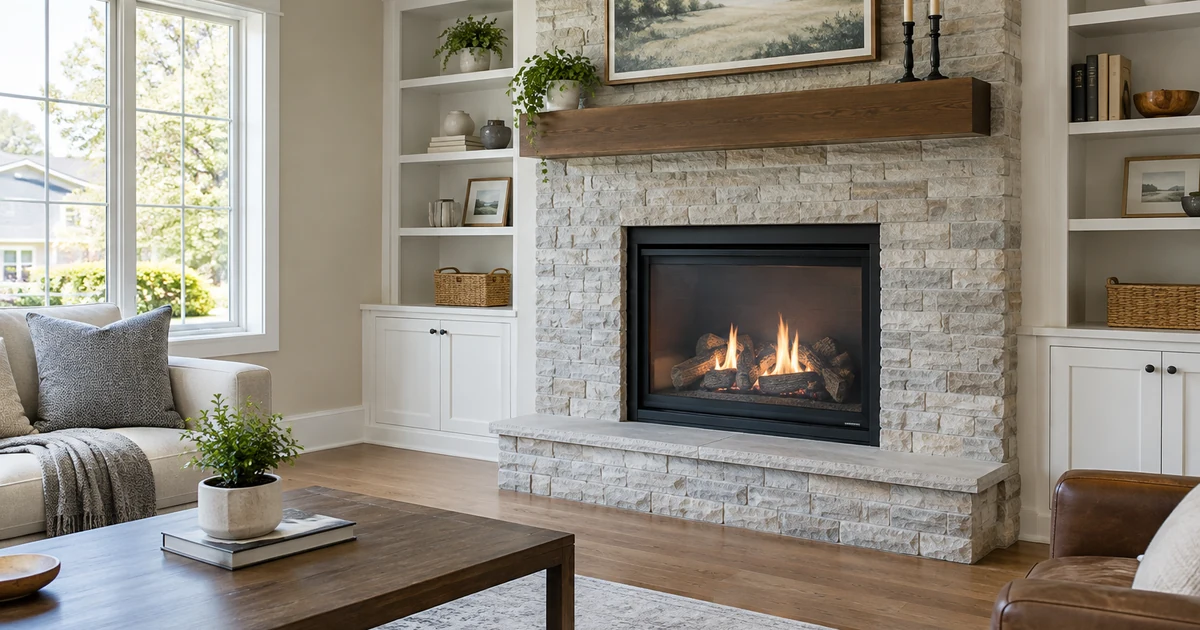
Gas Fireplace Cost to Install by Type
The style of fireplace you choose sets the budget more than anything else. An insert drops into a masonry fireplace you already have, a built-in (zero-clearance) unit needs a framed wall or chase, a freestanding gas stove sits in the room like a wood stove, and a vent-free unit skips the flue entirely.
| Fireplace type | Installed cost | Venting | Best for |
|---|---|---|---|
| Gas insert | $2,000–$5,000 | Liner through existing chimney | Converting a drafty wood fireplace |
| Built-in direct-vent (zero-clearance) | $3,200–$7,000 | Coaxial pipe through wall or roof | Adding a fireplace where none exists |
| Freestanding gas stove | $1,700–$4,300 | Direct vent or existing flue | Basements, cabins, open rooms |
| Vent-free (ventless) | $1,000–$4,600 | None | Occasional supplemental heat, where allowed |
| Custom masonry gas fireplace | $8,000–$20,000 | New masonry chimney or chase | Statement fireplaces and new builds |
These are installed prices for the unit, venting and standard labor. National averages vary by source: HomeGuide puts the average gas fireplace project around $6,200, while Fixr’s average is higher because it includes more custom builds with stone surrounds and mantels. A typical new built-in direct-vent fireplace with a short gas extension lands near $5,500.
Freestanding stoves look cheap on the price tag, but the total climbs if the stove needs a new direct-vent run through a wall or roof. Custom masonry fireplaces sit at the top because the mason builds the firebox, chimney and hearth on site.
Vented vs. vent-free gas fireplaces
Vented units come in two main styles. Direct-vent fireplaces use a sealed glass front and a two-layer (coaxial) pipe that pulls combustion air from outside and sends exhaust back out. They are the most common choice for new installs because they work with tight, modern homes. B-vent (natural vent) units draw room air and vent exhaust up a vertical flue; they cost less but lose more heat up the chimney and are less common today.
Vent-free fireplaces burn without a flue, so they are the cheapest to install, often $1,000 to $5,000 total. They release combustion byproducts and moisture into the room, rely on an oxygen depletion sensor to shut off, and are not allowed everywhere. California and Massachusetts ban ventless fireplaces, they are not permitted in HUD housing, and some cities and counties restrict them in bedrooms or entirely. Check with your local building department before you buy one.
Gas Fireplace Insert Cost
A gas fireplace insert is a sealed firebox that slides into an existing wood-burning fireplace, turning an inefficient open hearth into a controllable heater. Most homeowners pay $2,000 to $5,000 installed, and Angi puts the average around $3,700. Labor for a straightforward insert runs about $500 to $1,500, and added venting or chimney work can add $1,000 or more.
| Insert cost item | Typical cost |
|---|---|
| Gas insert unit | $1,000–$3,500 |
| Installation labor | $500–$1,500 for a straightforward job |
| Chimney liner and vent kit | $600–$2,500 |
| Chimney cleaning before install | $100–$150 |
| Chimney repair if needed | $160–$750 |
| New or extended gas line | $200–$1,000 |
| Permit | $100–$400 |
Most direct-vent inserts vent through two flexible aluminum or stainless liners (one for intake, one for exhaust) run down the existing flue, which is why the chimney must be cleaned and inspected first. Cracked flue tiles or a damaged crown add cost; see our guide to chimney repair cost for typical prices.
Gas log sets are the cheapest way to put a gas flame in an existing fireplace, often $180 to $1,100 for the set, but they are mostly decorative. An insert costs more because it actually heats the room and lets you close off the old chimney’s draft.
Cost Breakdown: Materials vs. Labor
HomeGuide splits a typical gas fireplace project into roughly $1,100 to $4,000 in materials and $1,200 to $6,000 in labor. Labor climbs with framing, venting distance and finish work.
- Fireplace unit: $700–$1,300 for a basic vent-free model; $1,600–$3,000 for a typical direct-vent firebox; more for large linear models
- Venting: $200–$3,000 (averaging about $1,200) depending on length and whether it goes through a wall or the roof
- Gas line: $250–$500 to extend an existing line; $350–$2,000 for a new run, or about $15 to $50 per foot
- Installation labor: $500–$1,500 for a simple insert; $1,200–$6,000 for a framed built-in with venting
- Permit: $100–$500, usually pulled by the installer
- Finish work: mantel $500–$5,000, glass doors $600–$2,000, blower $100–$500
Fireplace installers bill roughly $83 to $151 per hour according to Fixr, but most quote gas fireplace jobs as a flat package that includes venting and startup.
What a complete installation quote should include
Comparing bids is easier when you know the usual sequence of work for a new built-in unit:
- Site visit to confirm the location, venting path, clearances and gas supply size.
- Framing the opening or chase to the manufacturer’s dimensions, with required clearances to combustibles.
- Setting and securing the firebox, then installing the vent pipe, wall or roof terminal and flashing.
- Running or extending the gas line, adding a shutoff valve and pressure-testing the connection.
- Wiring for the blower, remote receiver or electronic ignition if the model uses them.
- Finishing the surround and mantel with materials rated for the clearances in the installation manual.
- Startup, burner adjustment, leak check, the final inspection and a walkthrough of the controls.
A bid that is far below the others often leaves out the gas line, the permit or the finish work. Ask each installer to list those items separately so you can compare like for like.
Surround material costs
A surround of 5 to 25 square feet frames the firebox and protects nearby walls. Installed prices per square foot vary widely:
| Surround material | Installed cost per sq ft |
|---|---|
| Concrete | $5–$25 |
| Tile | $10–$50 |
| Metal | $15–$50 |
| Brick | $25–$50 |
| Stone veneer | $45–$75 |
| Natural stone | $50–$150 |
Other Factors That Affect the Price
Gas line distance
If a gas stub is already nearby, connection is simple. Running a new line from the meter, especially to a second floor or across a finished basement, can add $500 to $2,000. Homes on propane may also need a tank or regulator changes. Our gas line installation cost guide breaks those runs down by length.
Venting path
A direct-vent fireplace on an exterior wall can vent straight out the back, which keeps costs low. Interior locations need a vertical run through the ceiling and roof, more pipe and roof flashing. Chimney liners for inserts run about $30 to $120 per foot installed.
Framing and chase construction
Built-in units need a framed enclosure finished with drywall, stone or tile. Building a bump-out chase on the outside of the house adds framing, siding and roofing work, which can push a project well past $10,000.
Existing chimney condition
Converting a wood fireplace starts with a cleaning and inspection. Angi lists chimney cleaning at $100 to $150 and repairs at $160 to $750, while a full chimney rebuild can cost $1,000 to $5,000.
Removal of an old unit
Pulling out an old insert typically costs $600 to $2,500. Replacing an old gas fireplace with a new one, including removal and venting adjustments, often lands around $1,000 to $1,850 in labor.
Electrical work
Blowers, remote-ready ignition and accent lighting need a nearby outlet or a new circuit. Adding one usually costs a few hundred dollars from a licensed electrician.
Size, style and heat output
Larger fireboxes and wide linear models cost more than a standard 36-inch traditional unit, and higher BTU ratings usually mean a higher price. Oversizing also wastes money: a unit that is too powerful for the room will cycle constantly or feel uncomfortably hot, so ask the installer to size it to the space you want to heat. Features such as a modulating valve, a built-in blower, a remote with a thermostat or a see-through (two-sided) design each push the unit price up.
Fuel type
Natural gas and propane units cost about the same to install, but propane is more expensive to burn. HomeGuide estimates roughly $0.70 per hour to run a natural gas fireplace versus about $2.30 per hour on propane.
Before you hire: get at least three written, itemized quotes from licensed and insured local pros. Prices for the same job often differ by 30% or more, and comparing line items is the fastest way to spot padding or missing work.
DIY vs. Hiring a Pro
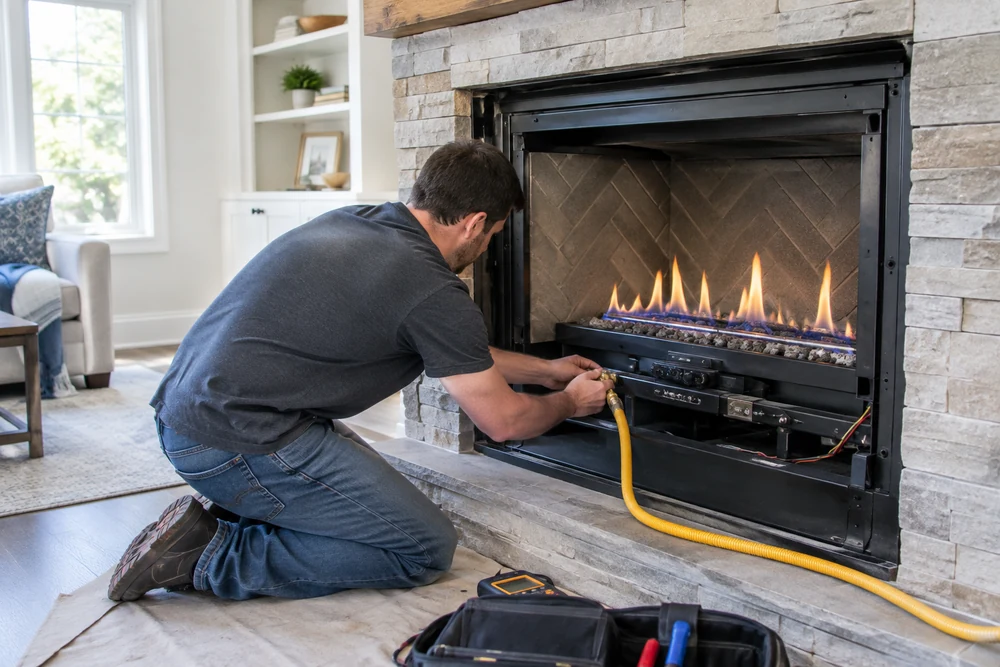
Gas fireplace installation is not a DIY project. It involves gas piping, combustion venting and clearances to framing that local codes regulate, and most jurisdictions require a permit and inspection. Manufacturers also typically require professional installation to keep the warranty valid.
Hire a licensed, insured installer (many are certified by the National Fireplace Institute) and a licensed plumber or gas fitter for the gas connection. A poor connection can leak, and a blocked or disconnected vent can let carbon monoxide build up in the house.
What you can reasonably handle yourself: choosing the unit, painting or tiling a surround after the installer finishes, and booking the yearly service visit.
Operating and Maintenance Costs
Once installed, a gas fireplace is inexpensive to keep running compared with the purchase price. Plan for these ongoing costs:
- Fuel: about $400 to $640 per heating season for regular use, according to Angi, depending on local gas prices and how often you run it.
- Annual inspection and service: $75 to $200 to clean the burner and logs, check the pilot or ignition, test for leaks and confirm the vent is clear.
- Repairs: $200 to $1,000 for parts such as thermocouples, igniters, valves or blowers.
Direct-vent units with a sealed glass front keep most of the heat in the room. Turning the pilot off in summer (on models with a standing pilot) and using a thermostat or remote with a timer can trim fuel use further.
How to Save Money on a Gas Fireplace
- Put it on an exterior wall. A short horizontal direct-vent run costs far less than a vertical run through the roof.
- Use the chimney you have. If you already own a sound masonry fireplace, an insert is usually the cheapest way to get real heat from gas.
- Keep the gas run short. Placing the fireplace near an existing gas line or appliance can save hundreds of dollars.
- Get at least three quotes that list the unit model, vent kit, gas line, permit and finish work separately.
- Buy in spring or summer. Fireplace installers are busiest in fall; off-season installs are easier to schedule and sometimes discounted.
- Choose a simple surround. Tile or a metal surround costs a fraction of natural stone.
- Check local utility rebates. Some gas utilities offer rebates on high-efficiency direct-vent units. The federal 25C energy efficiency tax credit ended for property placed in service after December 31, 2025, so it does not apply to a 2026 installation.
If you are comparing heat sources, a wood stove installation can cost about the same, while a gas fireplace is easier to live with day to day. For whole-house heat, look at furnace replacement cost instead; a fireplace is best treated as zone heat for one or two rooms.
Frequently Asked Questions
How much does it cost to install a gas fireplace where there isn't one?
Adding a built-in direct-vent gas fireplace where none exists usually costs $3,200 to $7,000 for the unit, venting and labor, plus $250 to $2,000 for the gas line. With framing, a mantel and stone surround, many projects end up between $6,000 and $10,000.
How much does a gas fireplace insert cost installed?
Most gas fireplace inserts cost $2,000 to $5,000 installed, with an average around $3,700. The price includes the insert, a liner or vent kit through the existing chimney and the gas connection; chimney repairs are extra.
Is a vent-free gas fireplace cheaper?
Yes. Ventless units often cost $1,000 to $5,000 installed because no flue is needed. However, they are banned in California and Massachusetts, not permitted in HUD housing and restricted in some local codes, so confirm the rules before buying.
Do I need a permit to install a gas fireplace?
Almost always. Permits usually cost $100 to $500 and cover the gas line and venting. A licensed installer normally pulls the permit and schedules the inspection.
How much does it cost to run a gas fireplace?
HomeGuide estimates about $0.70 per hour on natural gas and about $2.30 per hour on propane. Angi puts typical fuel costs around $400 to $640 per heating season, depending on use and local gas prices.
Is there a tax credit for a gas fireplace in 2026?
No federal credit applies in 2026. The 25C energy efficient home improvement credit ended for property placed in service after December 31, 2025. Some gas utilities still offer rebates on high-efficiency models.